Two questions before you automate anything
Before a single build: the intake diagnostic. You will name a client's constraining step, pick the automation ladder rung it needs, and quote from evidence instead of a feature list.
💡 Dotted words are definitions
Any underlined term has a plain-English definition. Hover on desktop, tap on mobile.
✅ Quizzes keep score
Each section ends with a check. Running score in the top bar; final tally at the end. Your teacher-agent takes follow-up questions any time.
Every business is the same four-stage pipeline
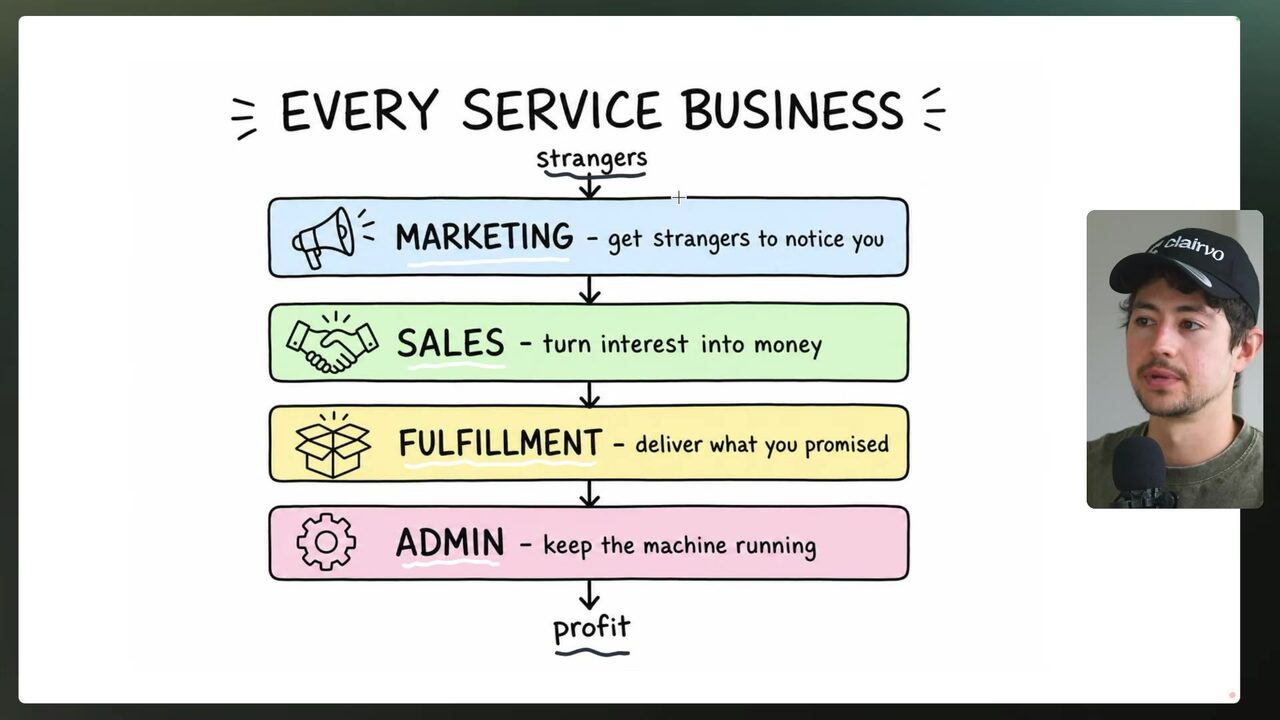
Nick Saraev frames every business, service or ecom, as one pipeline: marketing gets strangers to notice you, a sales transformation turns interest into money, fulfillment delivers what was promised, and an administrative wheel keeps the machine running. 0:48:34
On top of that pipeline he lays the RACE model: Reach, Acquire, Close, Expand. The line that matters for an agency sits between Acquire and Close: everything left of it is marketing, everything right of it is sales. This course, and your offers built from it, live entirely on the left. 0:49:58
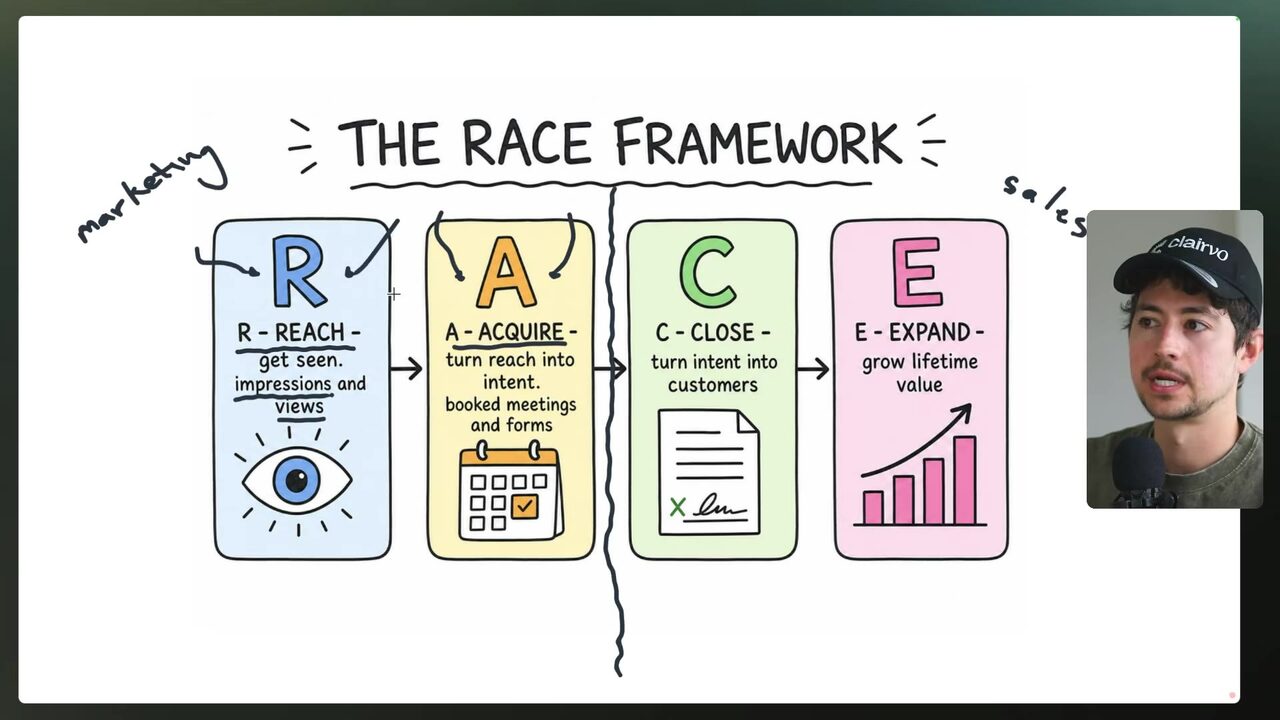
Where does the marketing/sales boundary sit in the RACE model?
Six sliders on one control panel
The course's five marketing functions map onto six adjustable levers, grouped under the two marketing stages. Under Reach: creative (AI-generated images, video, audio at volume), copy (per-recipient personalization), and outreach (outbound at scale). Under Acquire: speed to lead, booking percentage, and follow-ups. 0:53:00
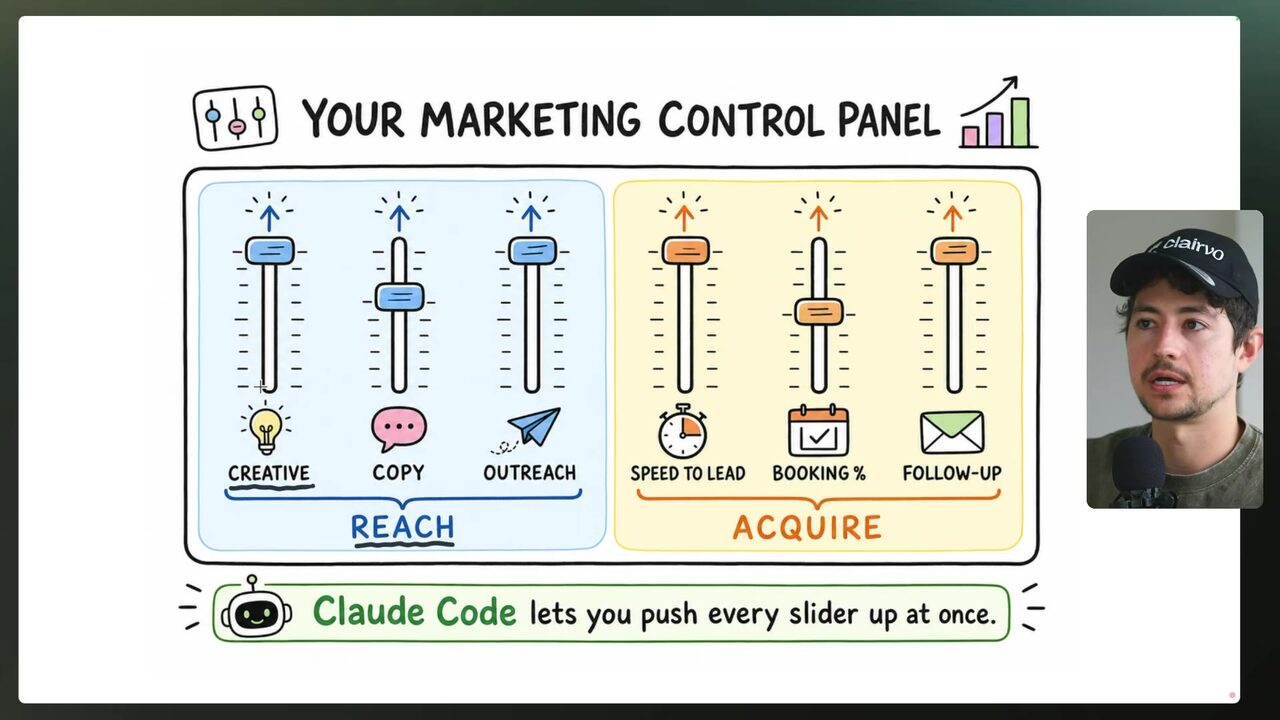
Two claims anchor the Acquire side, and both are the speaker's own numbers, logged in the claims ledger: he claims speed-to-lead systems can lift companies "300 to 400%", citing a home-services company that went from about $3M to $9M in monthly sales 0:55:37, and that shortening a 10-question form to 3 or 4 questions raises booking percentage, with Claude researching the prospect to replace the lost qualification data.
A client's ads get plenty of clicks but form fills sit unanswered for hours. Which lever is that?
Bottleneck thinking: the factory math
Before building anything, the course installs bottleneck thinking. The factory analogy: 100 units of raw material arrive daily, step A can process 100 units per day, step B can process 10. The factory's output is 10 units per day. Double step A to 200 and output is still 10. Double step B to 20 and the whole factory doubles. 0:58:24
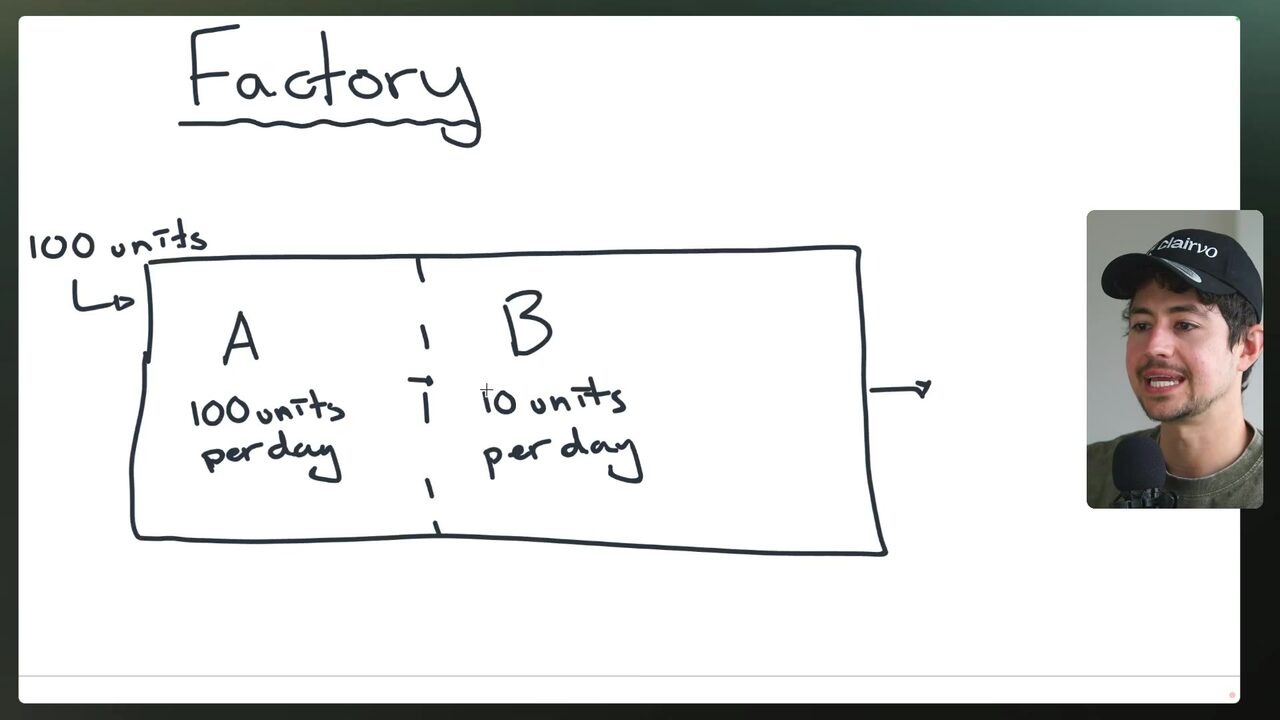
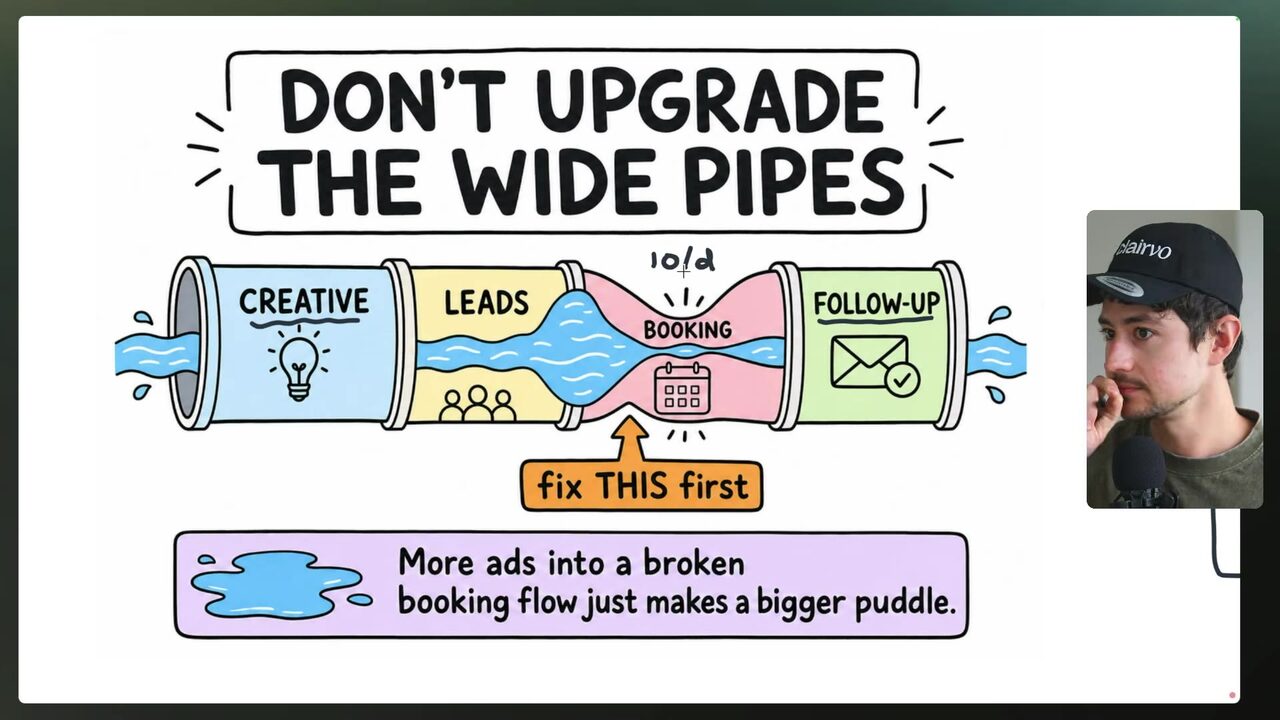
The consequence for your quotes is blunt: an automation system produces monetary return only when it targets the current constraining step. A creative system for a company whose constraint is booking is billable work that moves nothing. 1:02:17
In the factory example, doubling step A's capacity from 100 to 200 units per day changes total output by how much?
Prompt, skill, loop, routine
The second half of the diagnostic is the automation ladder: four rungs distinguished by what triggers them. A prompt runs when you type. A skill runs when you press run. A loop runs while your laptop is on. A cloud routine runs whether your laptop is on or not. 1:11:24
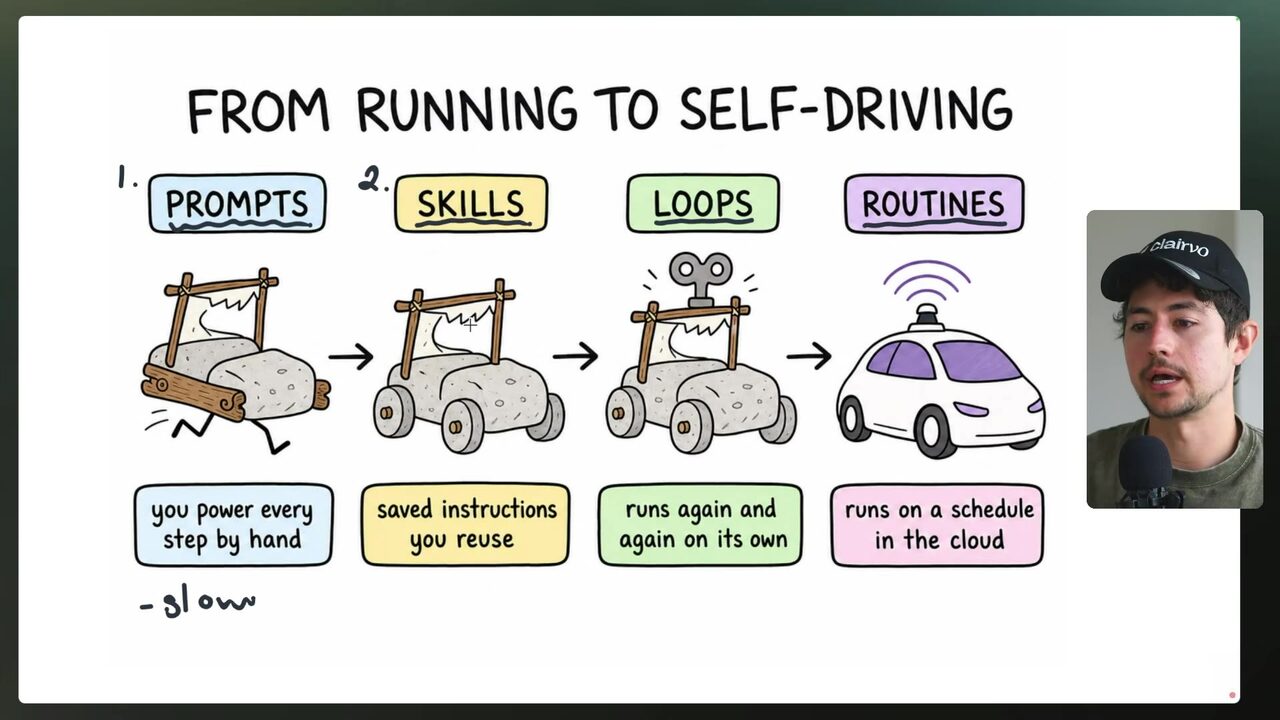
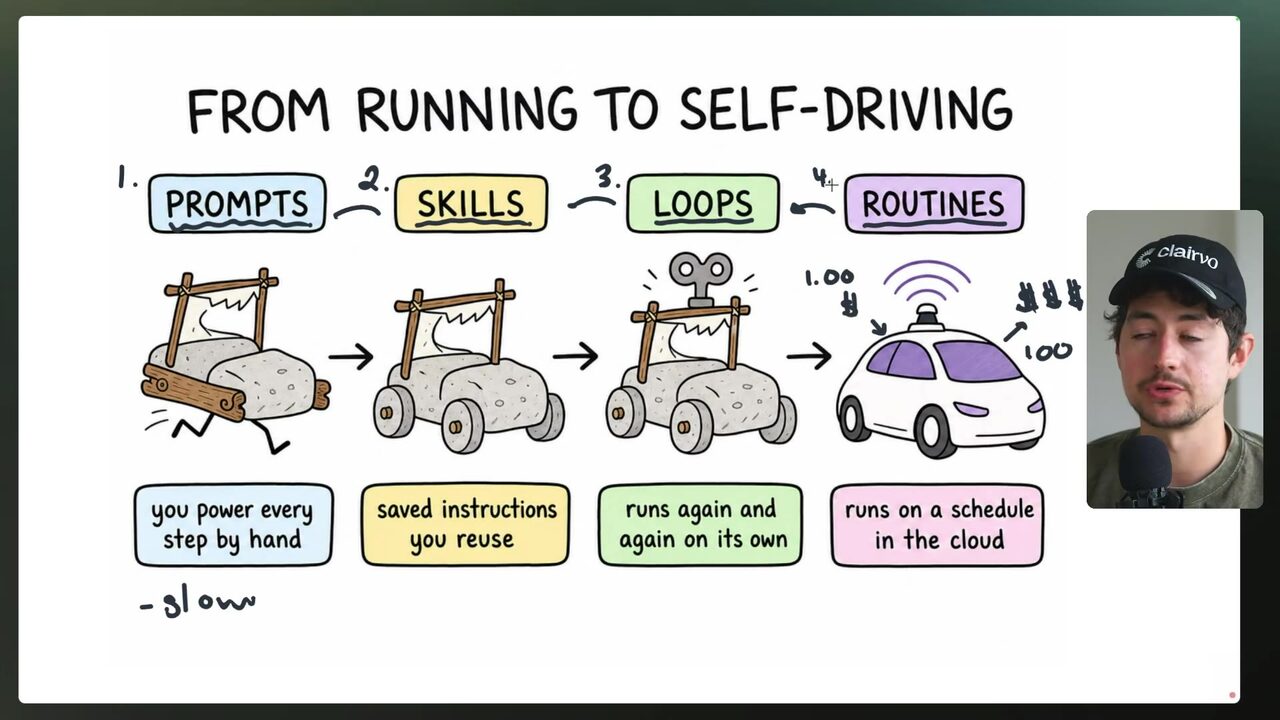
Use cases per rung, straight from the source: prompts for quick experimentation, skills for repeat tasks you still supervise, loops for monitoring and scraping on your own machine, routines for daily production a business can own. The speaker claims routine economics of roughly $1 in tokens per ~$100 of deliverable value, logged as a claim. 1:08:22
What actually separates a loop from a cloud routine on this ladder?
"Typed twice" and the 51.2% problem
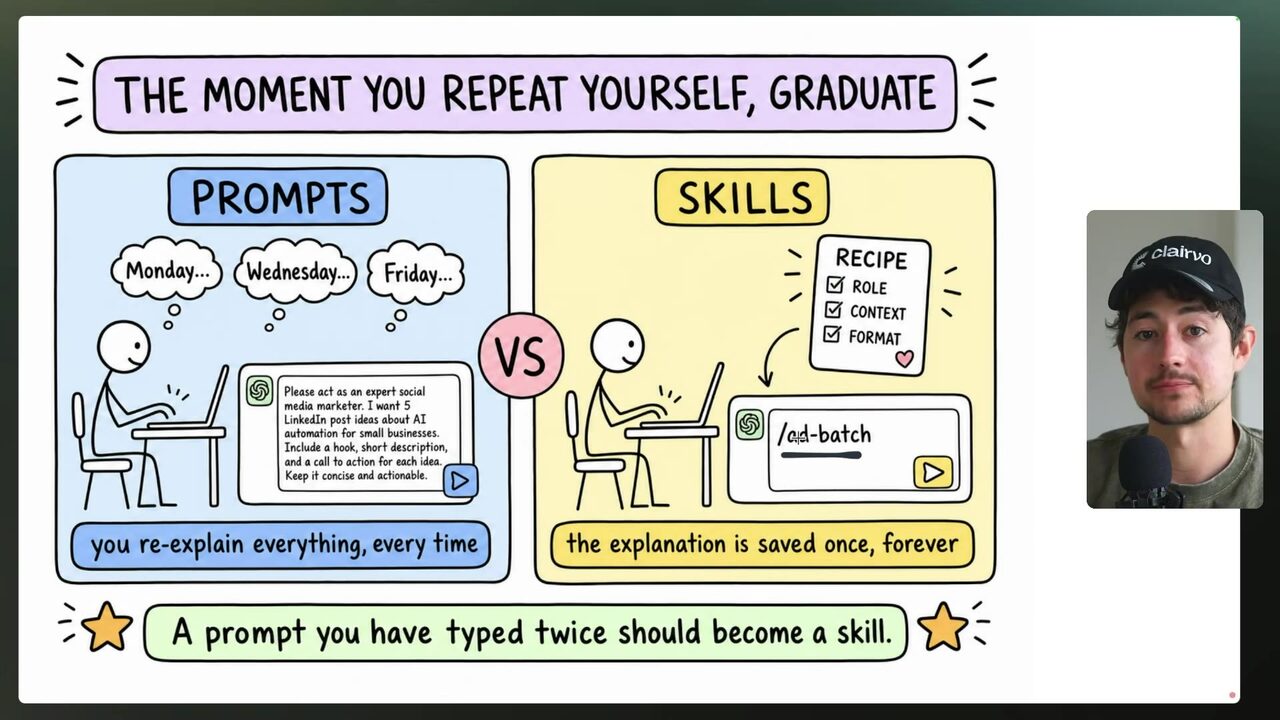
Two rules route all the work you will do in later lessons. First, the escalation rule: the moment you type the same prompt twice, turn it into a skill. Not everything converts; if a task cannot pass the autonomy barrier, the human stays in the driver's seat, and that is information too. 1:09:53
Second, the division of labor. Chain three steps that each succeed 80% of the time and the whole chain succeeds 0.8 × 0.8 × 0.8 = 51.2% of the time. The fix is not better luck: minimize the number of chained steps, and keep humans on the two ends, designing the process and judging the output, while AI executes the middle. 1:13:41
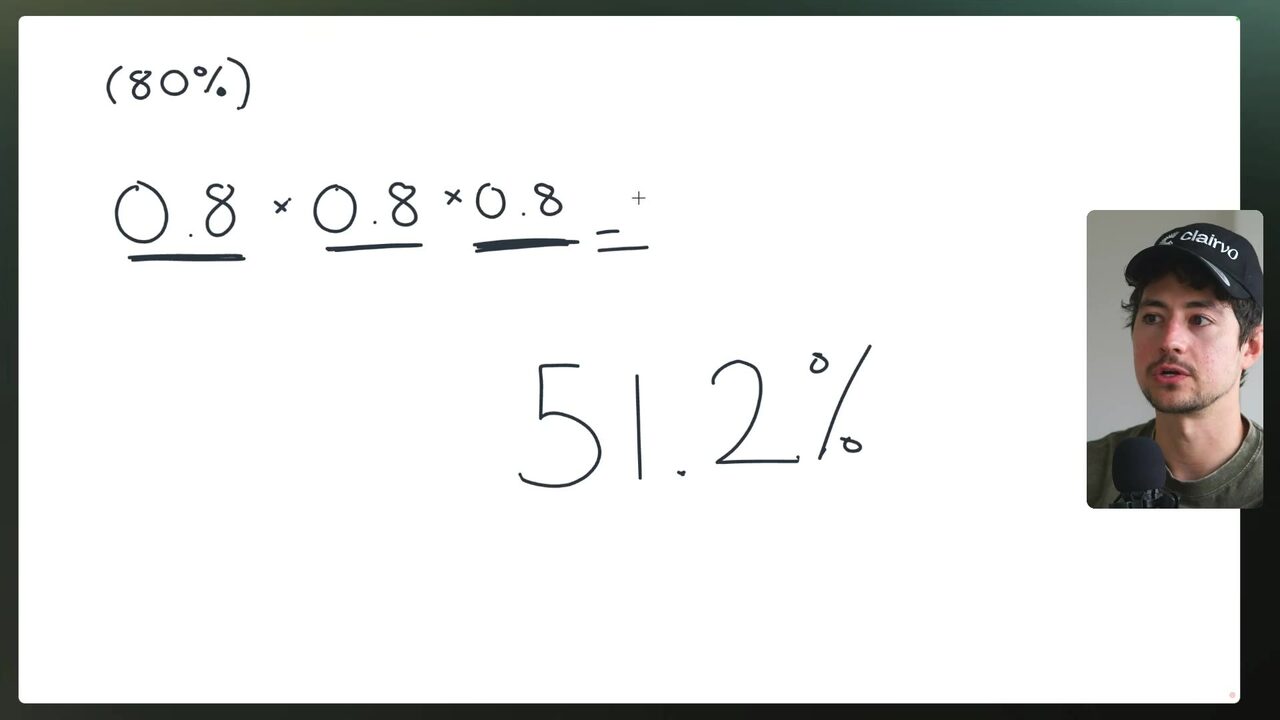
Why does the course insist humans keep the design and evaluation steps rather than delegating the whole chain?
The two-question intake diagnostic
Now assemble the lesson's deliverable, the thing you run on every Alexana client before quoting: a written diagnostic that answers exactly two questions.
Question 1: which step is the constraint? Walk the client's funnel left to right (creative → leads → speed-to-lead → booking → follow-ups) and find the narrow pipe: where does volume pile up or leak? Evidence beats opinion: response times, booking rates, follow-up counts. Question 2: which rung does it need? Match the fix to the lowest rung that solves it: a one-off analysis is a prompt; a repeated deliverable is a skill; monitoring is a loop; a system the client owns after handoff is a routine, which is also what you price as a product.
The output is one page: the named constraint, the evidence, the rung, and what you would explicitly NOT build yet (the wide pipes). Print the intake diagnostic card and the ladder card; they are this lesson compressed for a client call.
A client asks you to automate ad creative. Their forms answer within a minute, but 60% of booked calls never get a follow-up. What does the diagnostic say?
Your score
One-sentence summary
Automation earns money only when it widens a client's narrowest funnel step, so every engagement starts with two written answers: which step constrains, and which ladder rung fixes it.
Glossary
Every term marked with a dotted underline above. Skim it, or search the page for a word.
Ideas worth stealing into your own setup
Proposals, not done deals: nothing gets added to your system until you choose it.
01 The intake diagnostic as an Alexana biz-dev SOP
- Saw
- The course routes every build through bottleneck-plus-ladder before any tool is opened.
- Why
- Turns "what should we build you?" into an evidence document, and makes your quotes trace to a revenue lever.
- Form
- A one-page intake template in alexana-brand's biz-dev SOPs.
- Source
- 1:02:17 in the video
02 Speed-to-lead as the flagship client package
- Saw
- The claimed $3M-to-$9M home-services case rests on exactly the funnel stage your real-estate clients leak at.
- Why
- You already own the stack (forms, GHL, SMS); Lesson 8 builds the package end to end.
- Form
- A productized build for next-real-estate / rr-investment.
- Source
- 0:55:37 in the video