A branded ad batch from your own winners
From three saved reference formats to a 50-variant contact sheet with selectable winners, packaged as a skill that runs cold in a new session.
💡 Dotted words are definitions
Underlined terms have plain-English definitions. Hover on desktop, tap on mobile.
✅ Quizzes keep score
Each section ends with a check. Your teacher-agent takes follow-up questions any time.
Before the ad factory, run the bottleneck check
The whole pipeline only pays off under one condition: creative is the thing limiting performance. That is bottleneck thinking — companies with strong ideas and distribution but no creative capacity improve significantly, while companies short on ideas or reach gain nothing from more ads 1:15:51. The speaker discloses his own credibility: he claims his PPC company capped at roughly $200,000 in a year and calls 5–10x ROAS "okay but not the best"; he now runs ads for his own information and education products 1:16:10. He offers a "cookie cutter process" that is above average, but stresses that viewers should map out their own process and follow the steps to make it replicable 1:17:21.
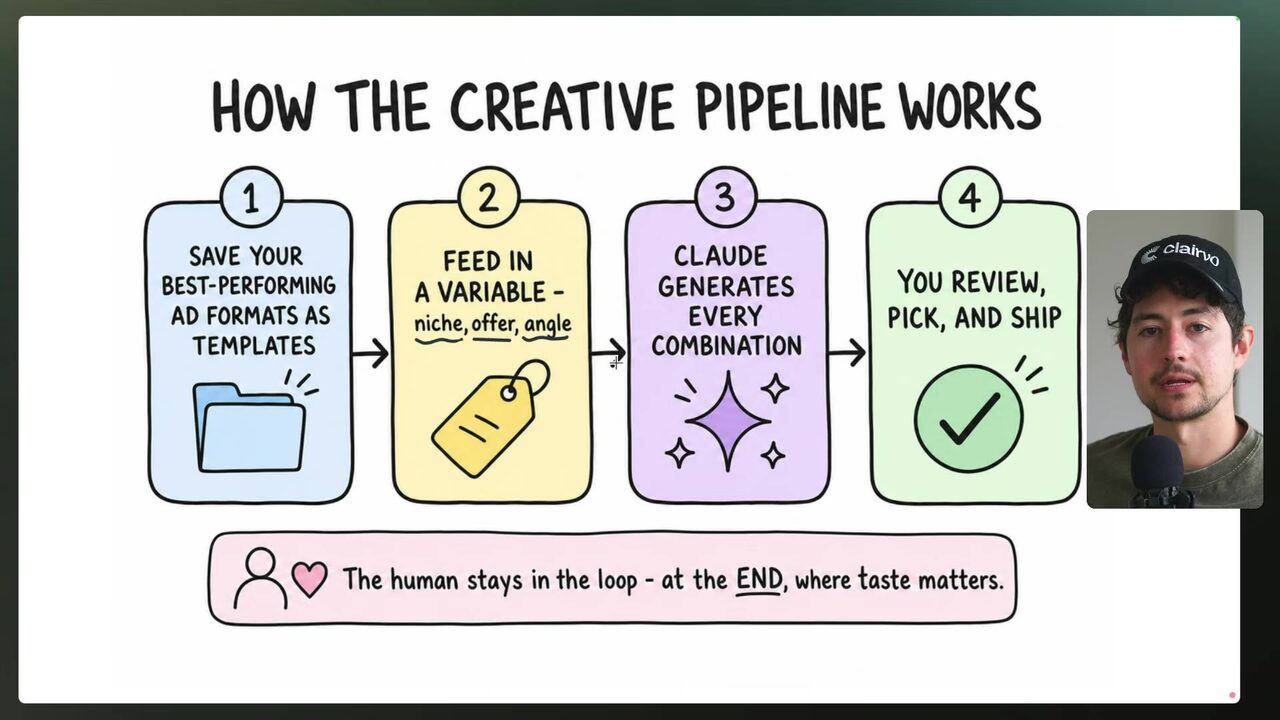
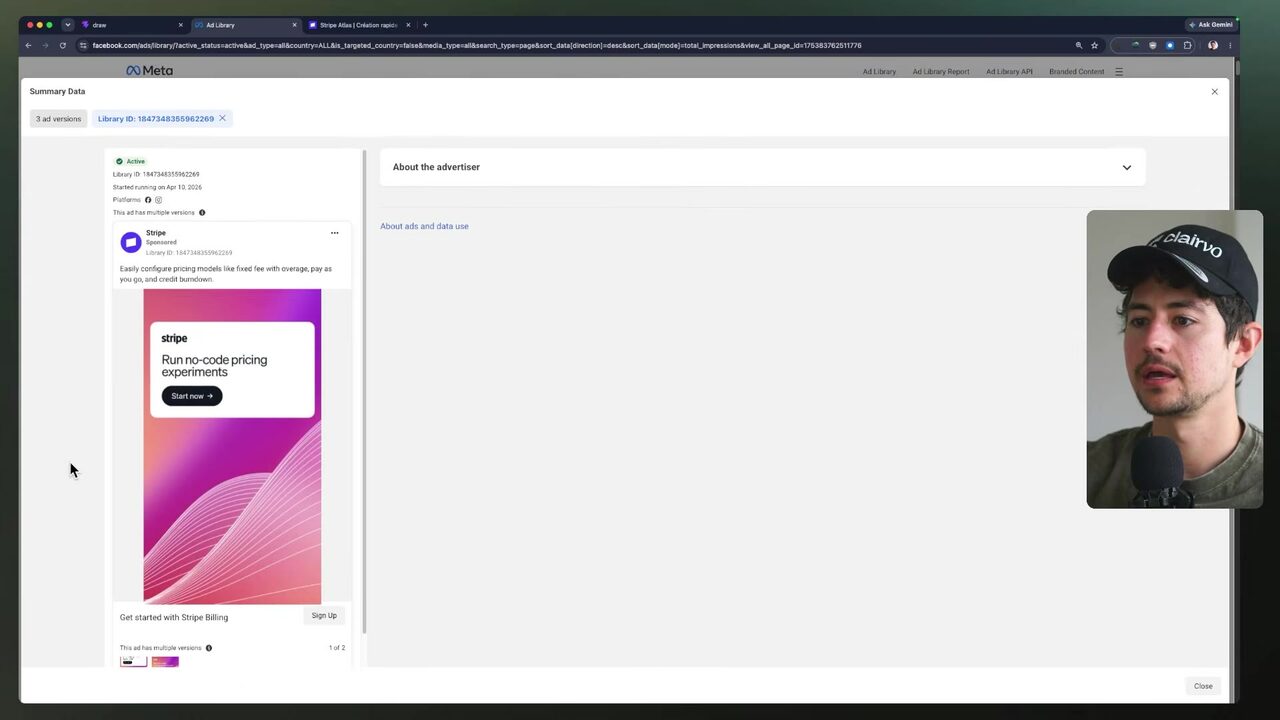
Step one of the pipeline is harvesting: find high-performing ad formats and save them as ad format templates. Since he lacks his own winners at first, he opens the Meta Ad Library, switches from Canada to "All" to see global ads while avoiding political ads, and studies Stripe's format — a high-quality gradient image in brand colors, a logo, text in a specific layout, a "Start Now" button, and simple videos 1:18:52.
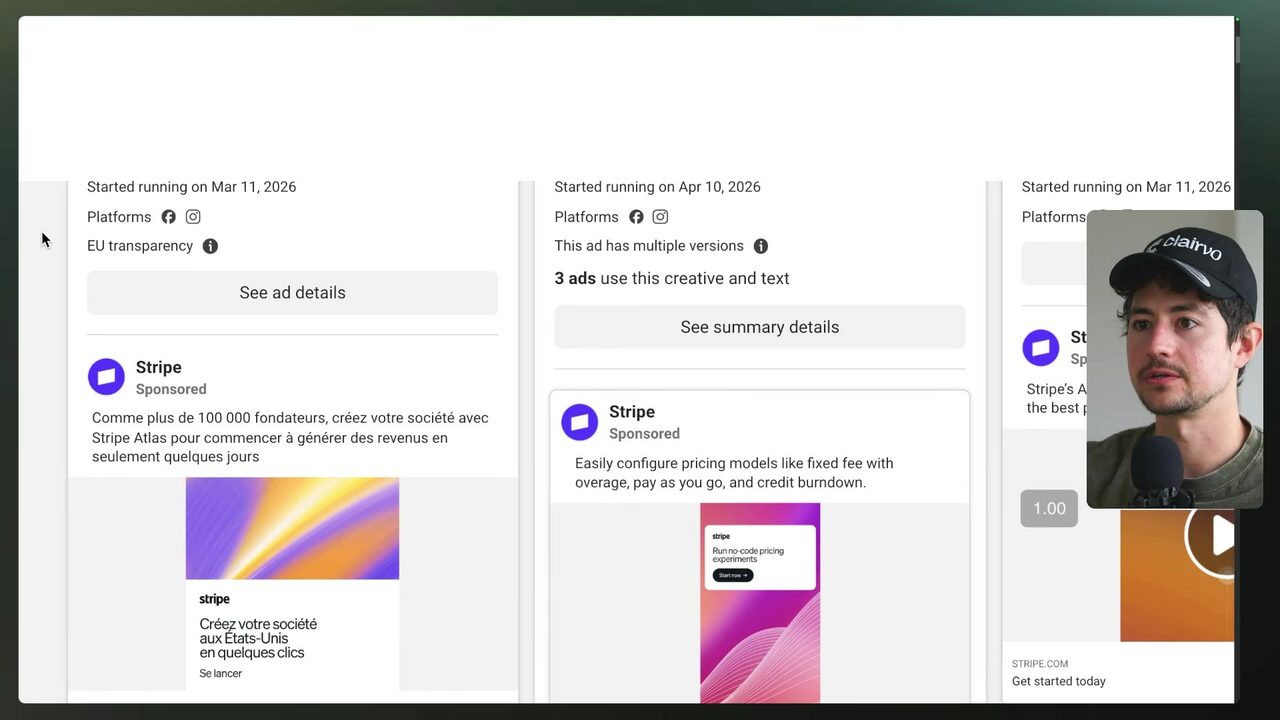
He zooms into each ad to capture the highest-quality screenshot possible and saves three into a Downloads folder named "ad formats for claude," noting that one is taller (mobile-specific) and the system should infer the aspect ratio natively rather than hardcode it 1:20:25. The folder discipline matters: fill it with your best formats, not "a bunch of shitty ads" 1:21:55.
Under which condition does the ad-generation pipeline actually improve a company's results?
Feed the product variable, let Claude decompose the format
Next comes the variable input: the product brief that gets swapped into the fixed formats. The speaker runs two products — Clarvo (raw transcript: "Claro"), a software-as-a-service dialer that automates dialing and routes only answered calls to agents, and Maker School, an AI automation program with a 90-day guarantee, daily coaching videos, and a community — and he picks Maker School because he knows it best 1:22:00. He uses voice transcription in Claude to dump the offer (90-day money-back guarantee, $21,000 in discounts), the audience (freelancers, agency owners, marketers, ex-corporate professionals), and the request to scaffold ads matching the saved formats; the screenshot folder goes into the same prompt 1:23:26.
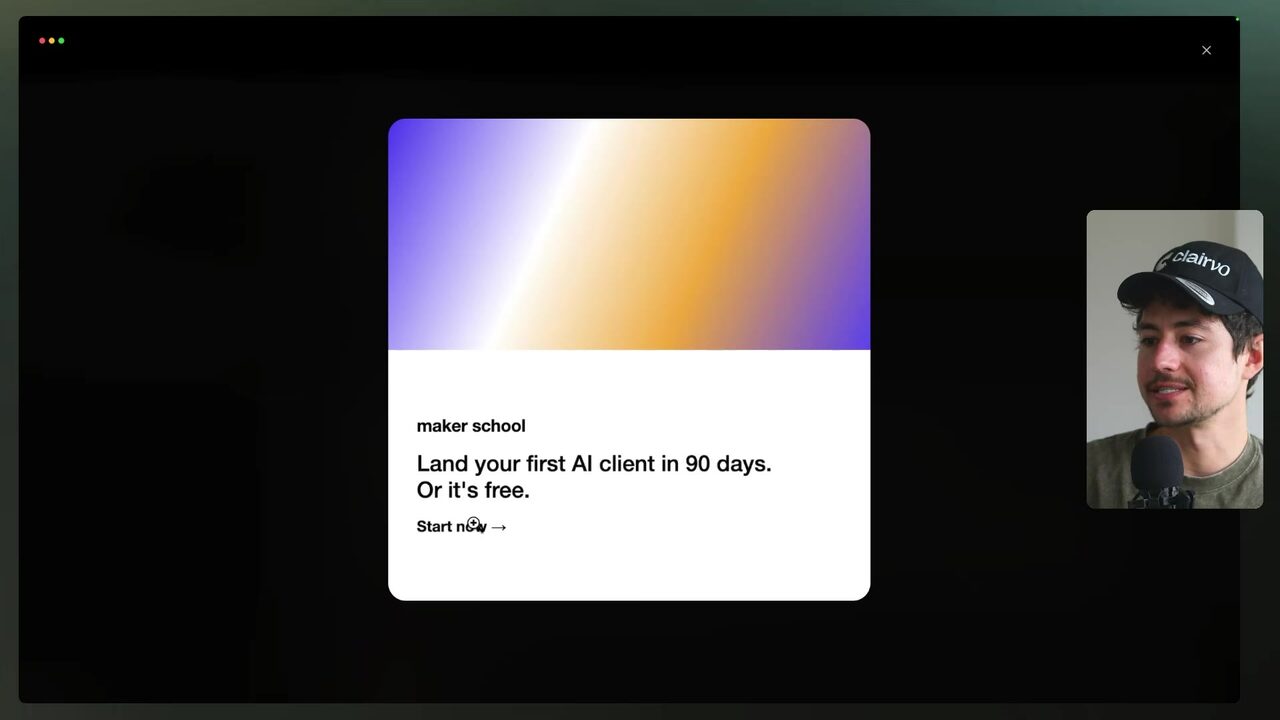
Claude's decomposition is the key output: "Bright abstract gradient, wave graphic, bold short benefit driven headline, tiny wordmark logo, single CTA button or text, high contrast, very buildable" — and it asks whether a real Maker School logo exists, so the speaker typesets the name in a clean sans-serif instead 1:26:28. The architectural decision follows: Claude has no inherent image generation, so it builds templates with cheap image-processing platforms like ImageMagick; the speaker claims direct AI image generation runs about $2 per ad, or $200 for 100, which is significant for most operators 1:28:27. This compositing path produces an HTML template and a test image (test_stacked.png) that is "okay" but needs improvement.
Why does Claude build the first test ad through compositing instead of generating pixels directly?
Tune taste with sliders, export the settings as JSON
The test ad is close but not shipped. He uses voice command (Command+D) to ask Claude to build a web page with sliders for font, spacing, gradient angle, and more — an ad tuner — and Claude implements an SVG filter pipeline that reproduces the smooth meshed gradient procedurally 1:29:59. Claude self-manages errors and debugs by passing outputs back as inputs; prompts can take 15–20 minutes, and the icon turns yellow when done 1:31:30.
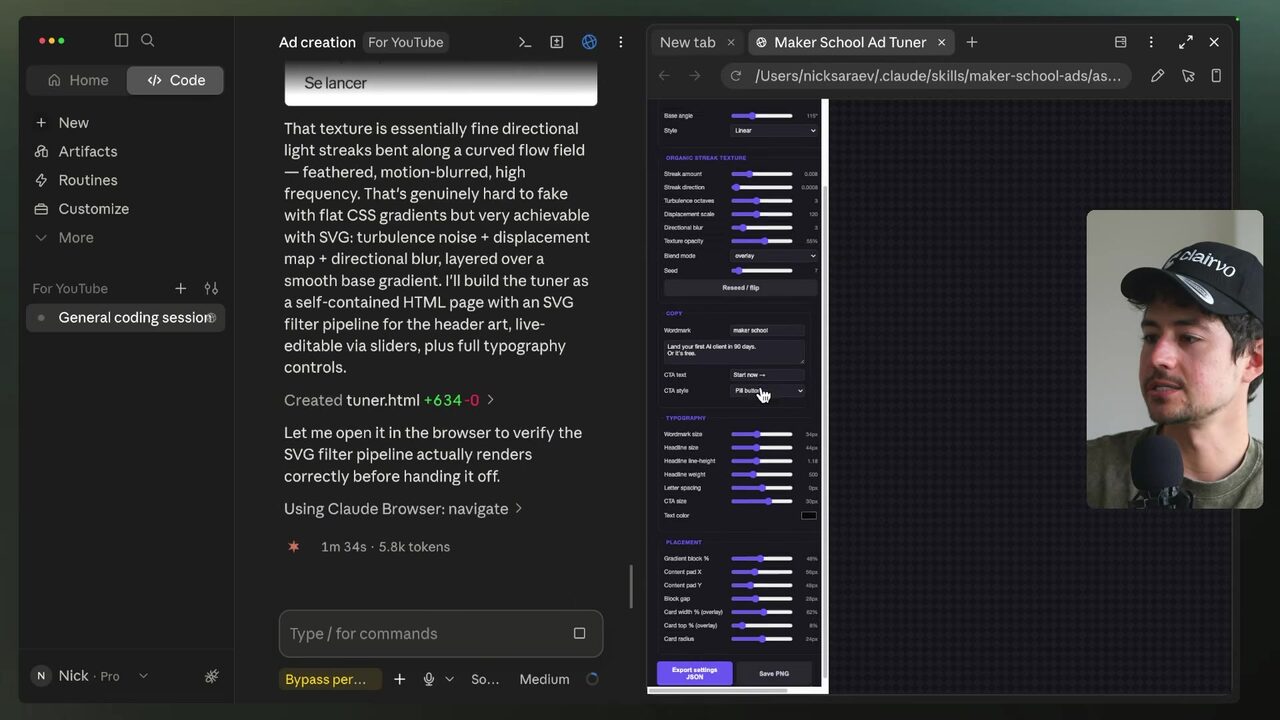
In the tuner he manually adjusts the design levers: gradient angle, noise, grain, seed, blend mode, font, letter spacing, and the CTA text — changing "Start Now" to "Join Now" 1:33:00.
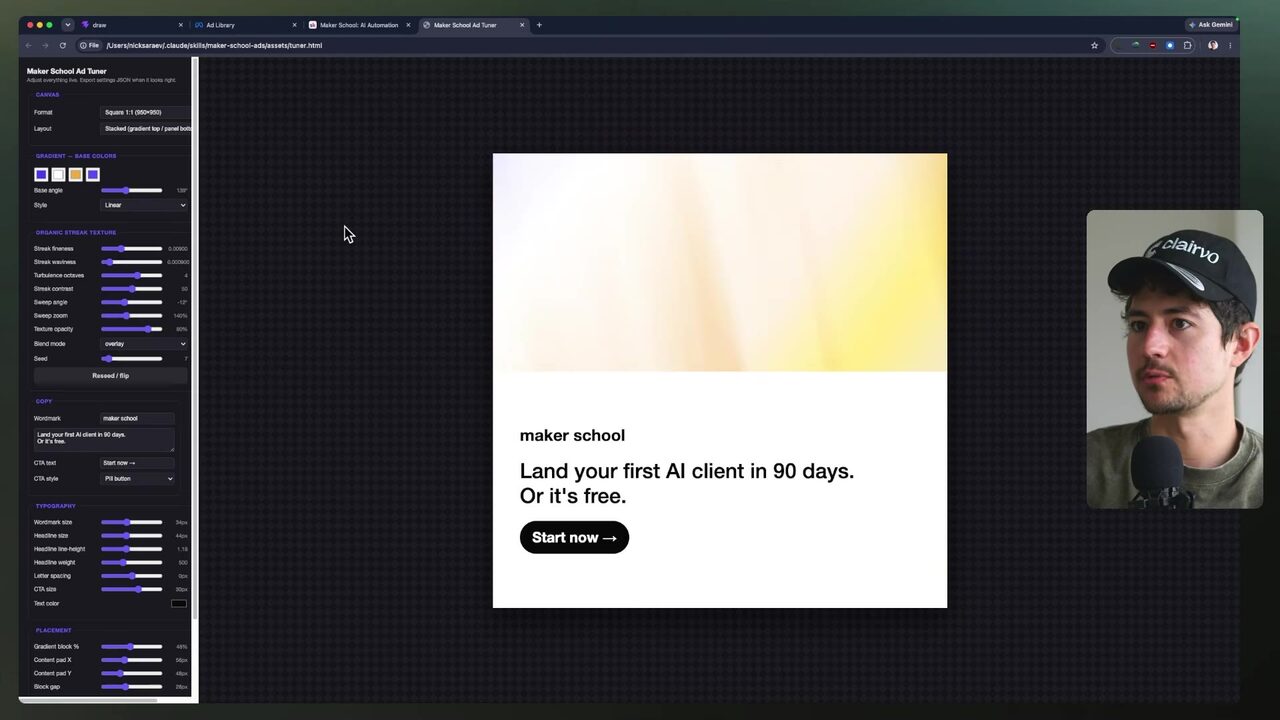
He adds a period to the headline: "Land your first client in 90 days or it's free." 1:36:08.
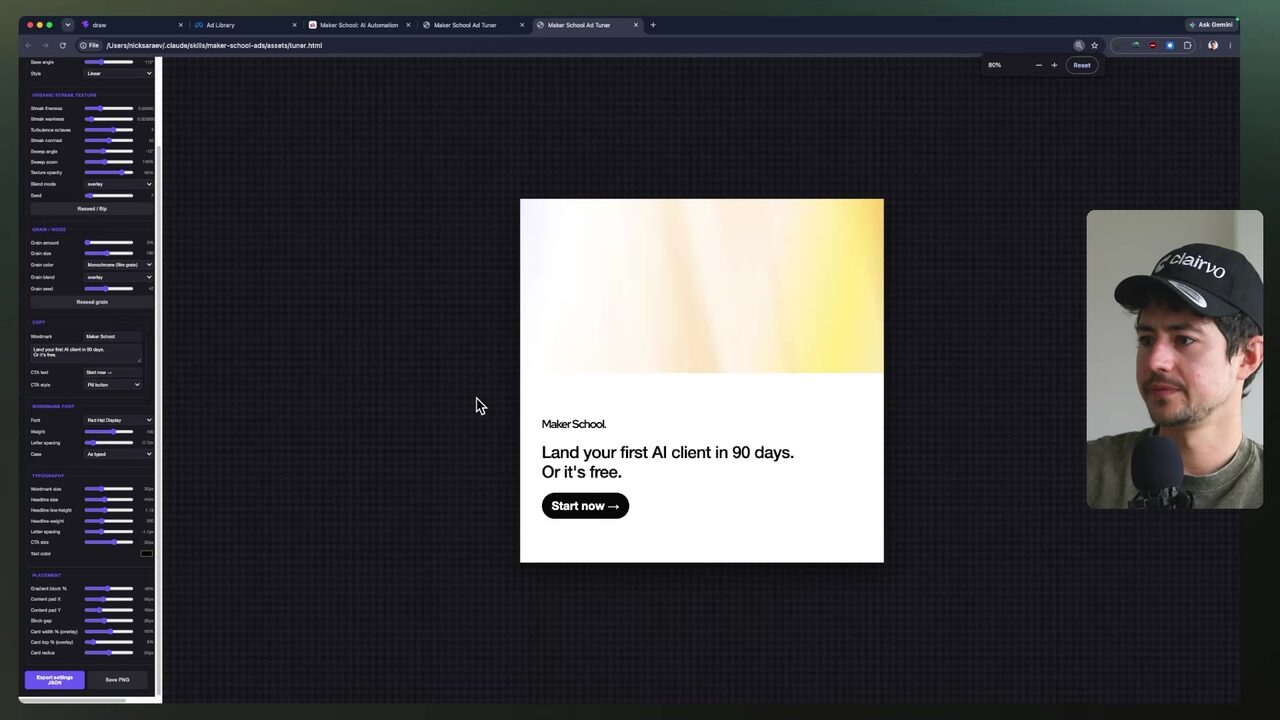
The payoff: he exports the tuned settings as JSON and copies them into Claude, so the taste decisions become data the generator can consume 1:37:28.
What makes the ad tuner the human-taste checkpoint in the pipeline?
Fifty variants on one contact sheet, then let the market vote
He asks Claude to apply the settings, generate 50 ads with different CTAs and looks, pick the best, and turn the flow into a reusable artifact or skill. Claude creates a script that iterates procedural variations and produces a contact sheet of 50 numbered variants — headlines like "Land your first AI client in 90 days or it's free" and "Get 21k in tools free" — of which he wants to keep four 1:38:58.
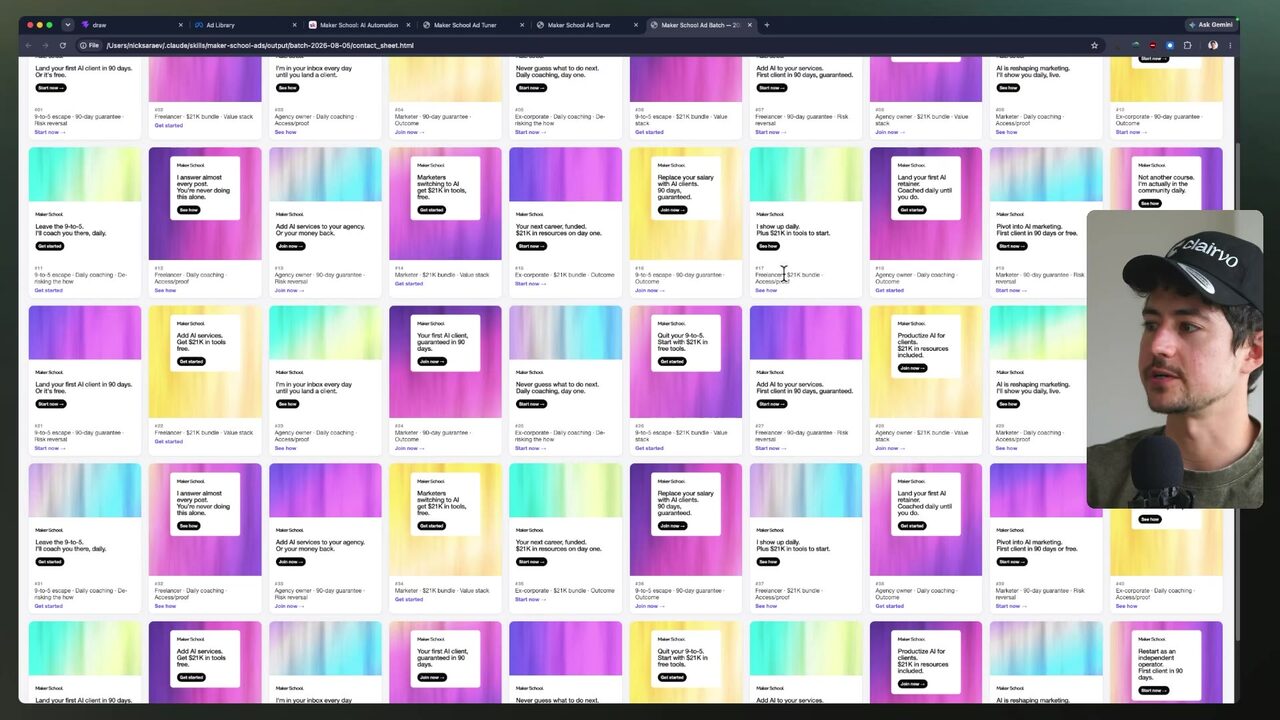
Feedback goes back via Command+D: vary the gradient angle so not every ad looks vertical, and add a select-and-download mechanism for winners 1:39:37. He also clarifies the strategic point: the idea is to scoop your own past winners or team-created templates, not just copy competitors, then generate variants fast 1:39:37. On economics, the speaker claims AI-generated video ads usually cost around $500 each to test, while this pipeline cuts the marginal cost toward $2 — letting you test 10x or 100x more ads and letting the market pick winners; he downloads the selected winners and notes they can be uploaded to Facebook Ads or any ad library manager 1:41:09.
What is the speaker's claimed cost advantage of the compositing pipeline for testing ads?
Package the flow as a skill and run it with zero context
The final move turns the whole conversation into a skill. Claude generates the skill.md file from the conversation, consolidating a distributed prompt into a reusable instruction set: "Generate stripe style minimalistic ad creative with an organic gradient header and bold headline plus CTA for Maker School, Nick's AI automation and coaching program" 1:42:40.
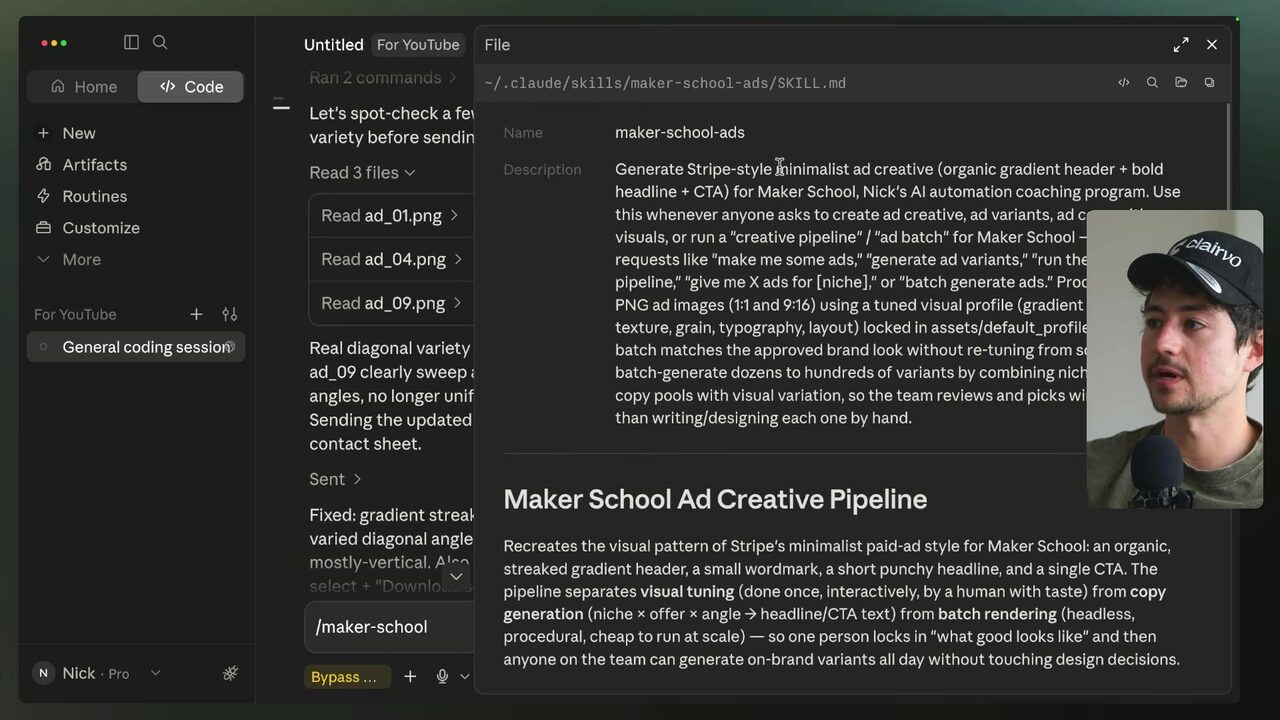
He proves it runs cold: in a new chat with zero context, he asks the skill to generate 10 ads for Clarvo (clarvo.io) and send a contact sheet. Claude researches the site, applies the skill, and returns ads like "Dial leads in seconds. Hit 85% pickup rates." 1:43:58 1:44:02.
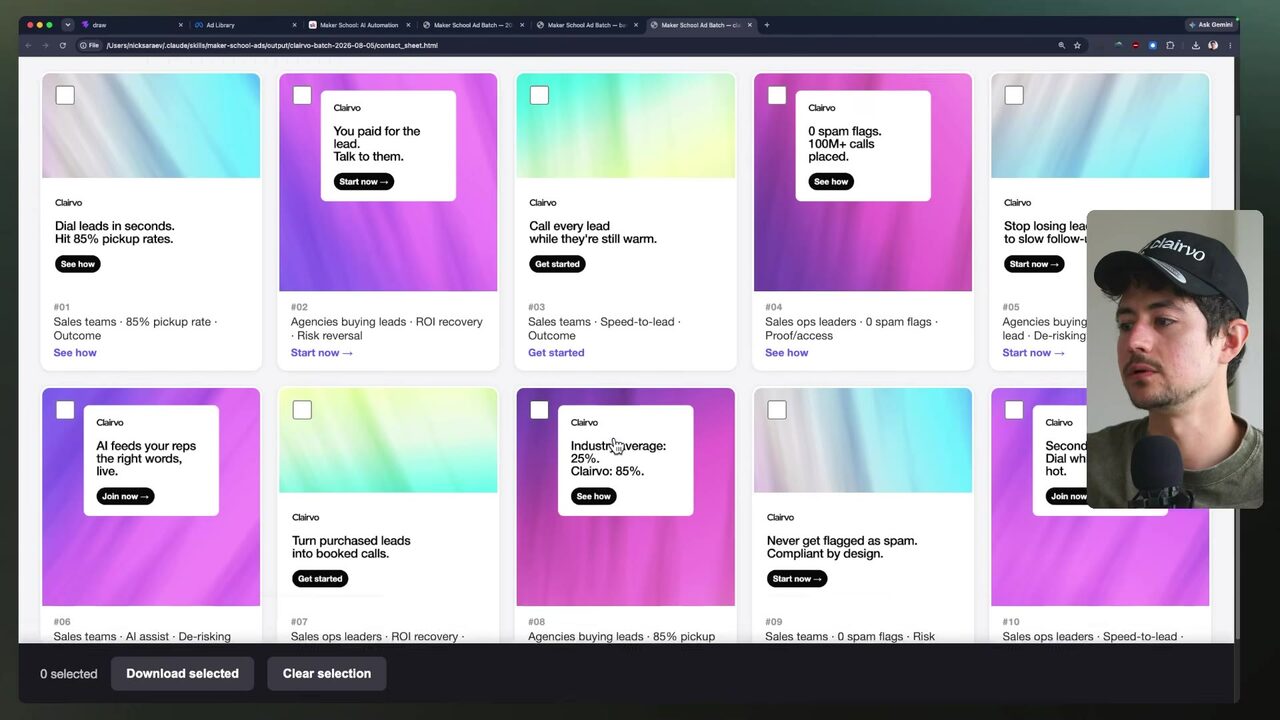
That zero-context run is a zero-context run and it is what makes the asset productizable: no chat history, no tuner session, just the skill file any teammate or client account can invoke. The endgame is a cold loop — a scheduled job that fires every morning at 5:59 a.m., generates a fresh batch, and hands it to a creative specialist for review at 6:00 a.m. 1:45:34. Adopt this as your productized recipe: harvest 3 proven formats → feed a voice-transcribed product variable → tune taste with the ad tuner → generate a 50-variant contact sheet → select winners → package the conversation as SKILL.md → run it cold for the next product or client.
What proves a packaged ad skill actually runs cold?
Your score
One-sentence summary
A productized ad-creative recipe: harvest three proven formats from the Meta Ad Library, feed in a voice-transcribed product variable, tune taste with an SVG ad tuner, generate a 50-variant contact sheet, and package the flow as a zero-context skill that runs cold on demand.
Glossary
Every term marked with a dotted underline above. Skim it, or search the page for a word.
Ideas worth stealing into your own setup
Proposals, not done deals: nothing gets added to your system until you choose it.
01 Client creative revival
- Saw
- Harvest 3 best-performing formats from the client's Meta Ad Library, feed the product variable via voice transcription, and deliver a 50-variant contact sheet.
- Why
- Turns a dormant ad account into a recurring creative engine with a human sign-off step.
- Form
- Monthly retainer deliverable
- Source
- 1:38:58 in the video
02 Skill library per client
- Saw
- Package each client's winning flow as a SKILL.md in a private GitHub repo, versioned and reusable.
- Why
- Any team member runs a zero-context batch without the original conversation or the operator's memory.
- Form
- Productized asset / onboarding kit
- Source
- 1:42:40 in the video
03 Daily creative alert
- Saw
- Wrap the skill in a scheduled loop that drops a dated variant folder into a shared Drive for the client's creative specialist.
- Why
- Moves the agency from campaign-by-campaign delivery to a standing pipeline that fills the creative queue every morning.
- Form
- Managed ad-creative subscription
- Source
- 1:45:34 in the video