When a generative model beats a template, and how to fence it in
A routing rule with numbers attached: compositing ~80% usable, direct generation ~25%, and the template-fencing technique that closes the gap.
💡 Dotted words are definitions
Underlined terms have plain-English definitions. Hover on desktop, tap on mobile.
✅ Quizzes keep score
Each section ends with a check. Your teacher-agent takes follow-up questions any time.
Two engines of the same pipeline
The creative pipeline has two distinct engines, and the speaker frames them by how pixels get made. Claude itself has no pixel-rendering ability: it drives compositing tools like Photoshop, Canva, or Microsoft Paint 1:55:34. Version 1 of his system hardcoded every pixel through compositing; version 2 is the shift to direct generation — image and video models steered by Claude that produce pixels directly, like GPT Image 2 1:57:32. He contrasts Premiere Pro (a video compositing tool) with video models like Sea Dance 2.5 (raw transcript: "Cance 2") 1:58:00, showing examples generated on Higgsfield (raw transcript: "Higsfield") 1:58:45.
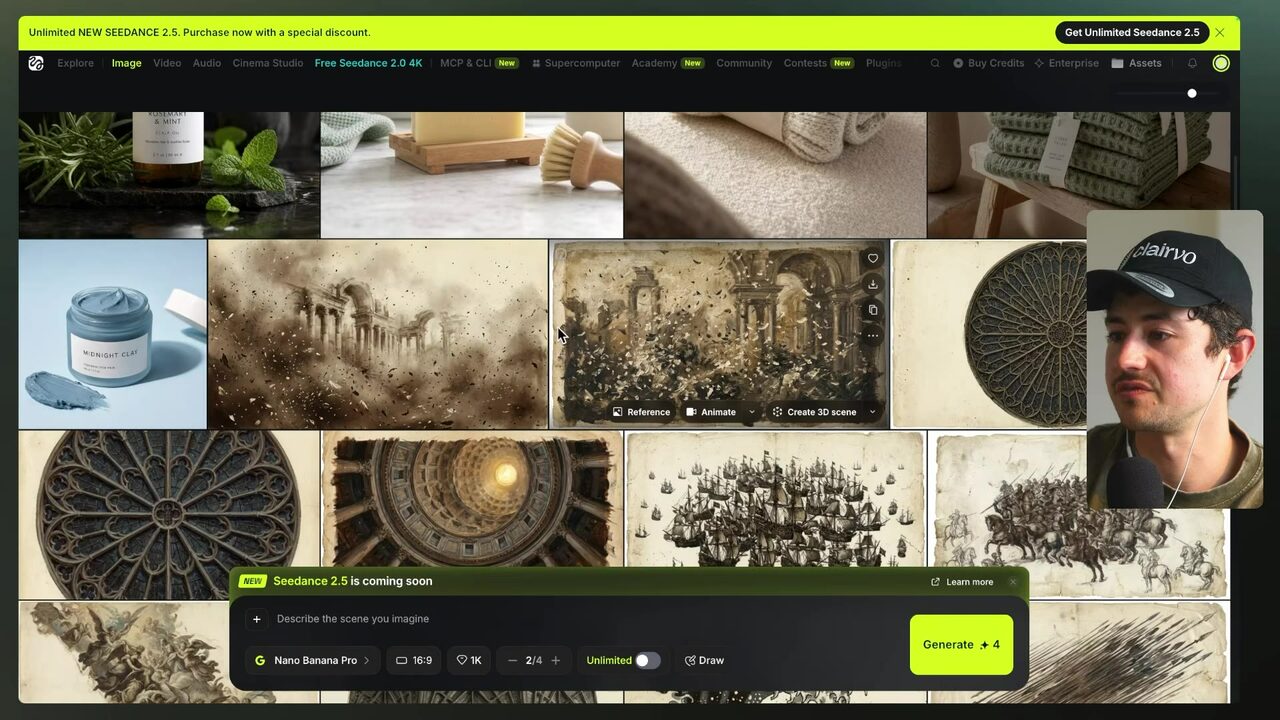
The speaker claims direct gen has roughly a 25% success rate versus 80% for compositing templates 2:00:32, and advises compositing for simple, cheap, repeatable tasks while reserving direct gen for more complicated work, at an average of about four generations per good result 2:00:54. The cost of that failure rate is the whole reason fencing matters.
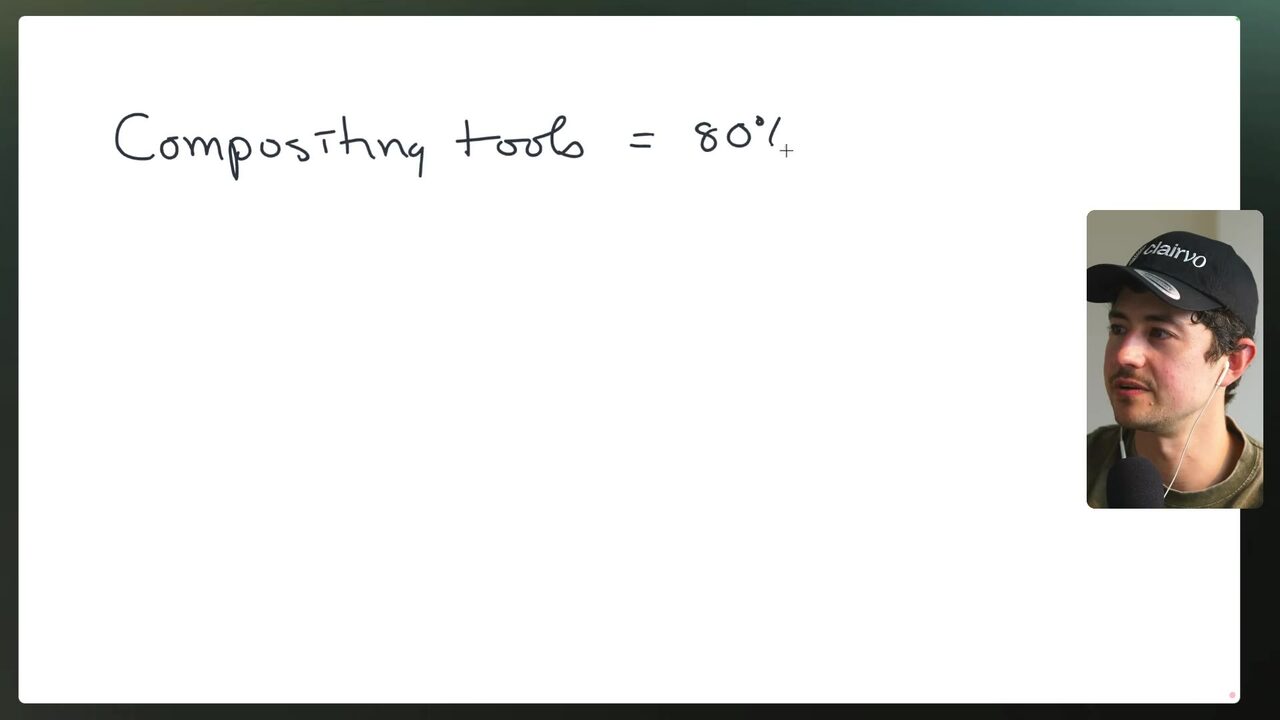
Which framing does the speaker use for choosing between composite and direct gen?
Cloud Socks: proving direct gen on a real product
He rebuilds the ad pipeline around a direct-gen model. The flow: save best-performing ad formats as templates, feed in a product variable, have Claude generate combinations, pass to GPT Image 2, then review, pick, and ship 2:02:25. From the Meta Ad Library he saves three sock-ad templates 2:03:41, including a Nordic Socks static image with the logo centered across four sock panels 2:05:06.
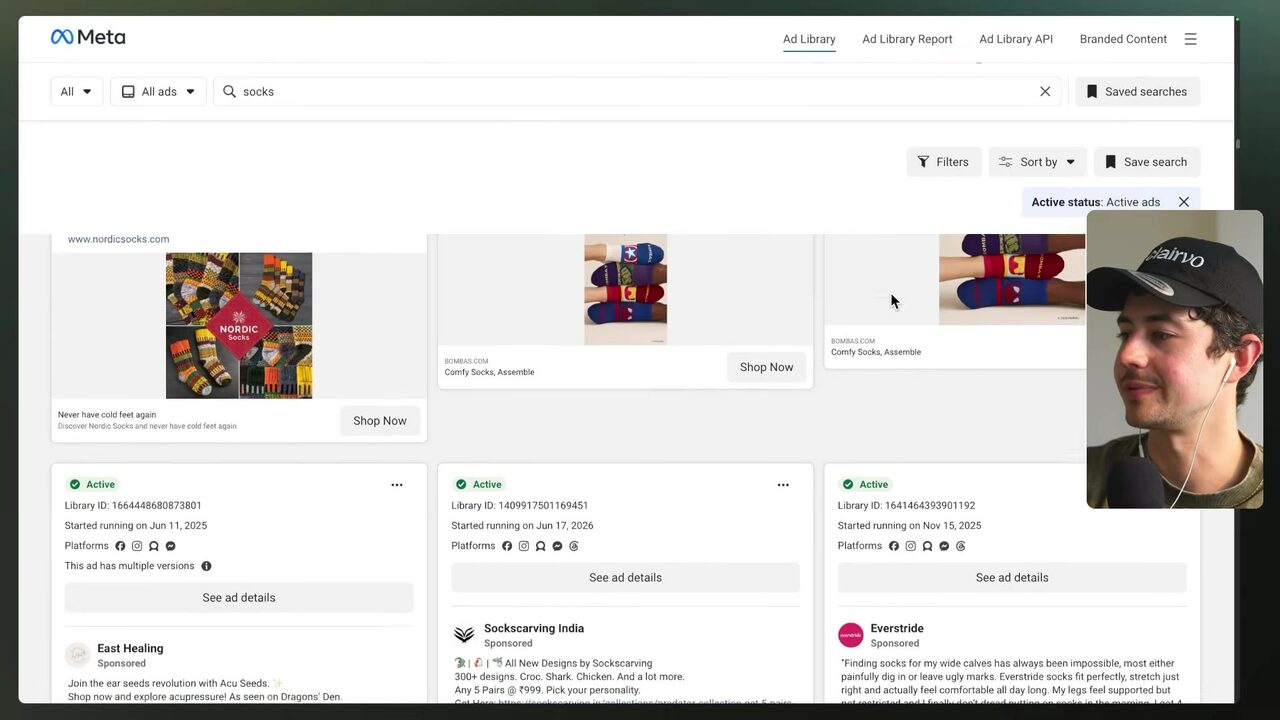
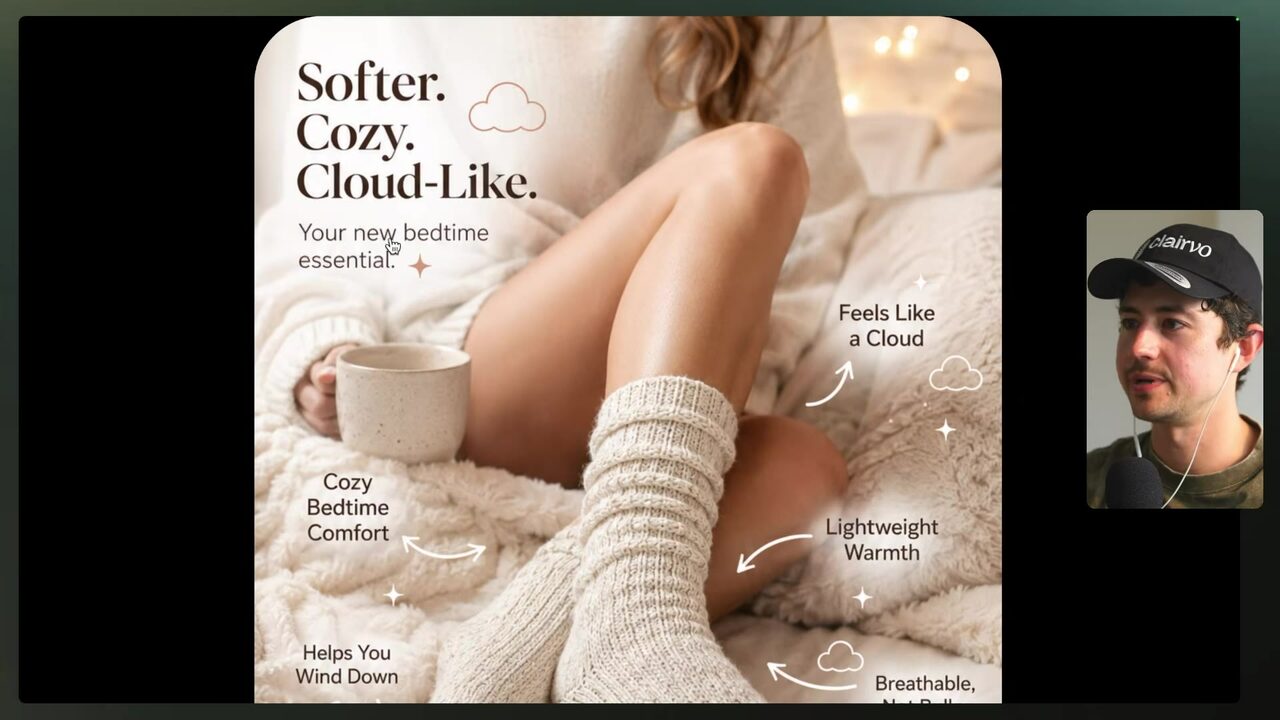
Two products anchor the test: Cloud Socks (merino wool sleep socks) and Linen Tails (a waffle towel bath sheet, 100% organic linen) 2:06:29. He tests GPT Image 2 directly first, converting a webp file to PNG because the free plan couldn't upload webp, then upgrading to the ChatGPT Plus plan to upload multiple images 2:07:00. He recommends at least the ChatGPT Go or Plus plan as of recording, since the free plan can't upload more than one image and interferes with API communication 2:09:00. Uploading the template and the product image, he prompts the model to apply the format while adding value props like "light, fluffy cloud sock that's cozy and helps you go to bed" 2:10:09, which yields the headline "Softer. Cozy. Cloud-Like. Your new bedtime essential." 2:10:45.
What was the concrete reason he upgraded off the free plan before testing?
Wiring an image API into Claude Code
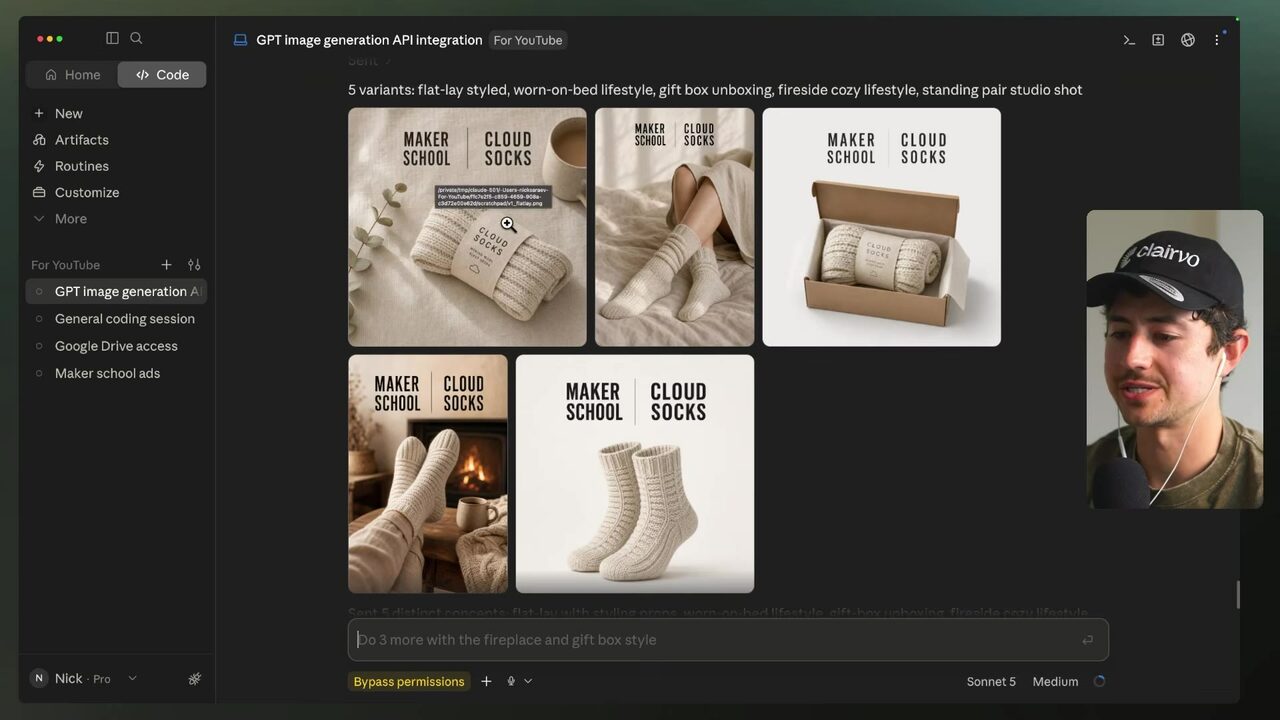
The bridge between Claude and the image model is an API key created in the OpenAI playground and exposed to Claude Code only as an environment variable 2:11:40. For security, Claude never holds the key value — only the variable name — specifically to prevent prompt injection from leaking the secret 2:13:10. He then asks Claude to research the GPT Image 2 API (functions, endpoints) and generate a basic test image from the socks template, correcting Claude when it reached for GPT Image 1 instead 2:14:25. Claude produces five variants, some branded "Maker School Cloud Socks" with product images and distinct layouts 2:16:40.
Why does Claude see only the variable name and not the key value?
Fencing the template: from 25% to 80%
The direct-gen failure rate is really a variance problem: more freedom increases variance and the chance of poor results — good for creativity, bad for repeatable business processes 2:17:30. He asks Claude to digest the image ad, identify levers to tweak, template out the changes, and generate with more conformity to the main image, aiming for an 80% success-rate template 2:18:24. Claude breaks the template into fixed geometric zones: a 0–20% logo band, 20–30% transition/negative space, and a 30–100% product band 2:19:45.
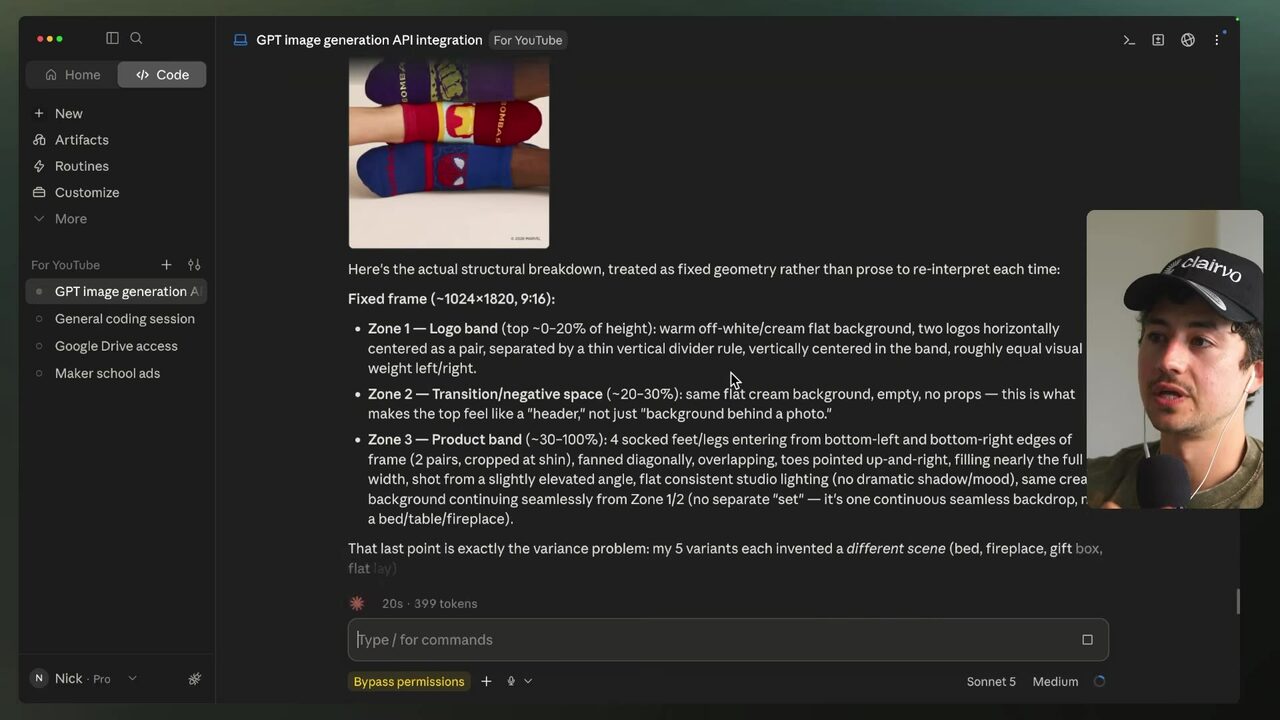
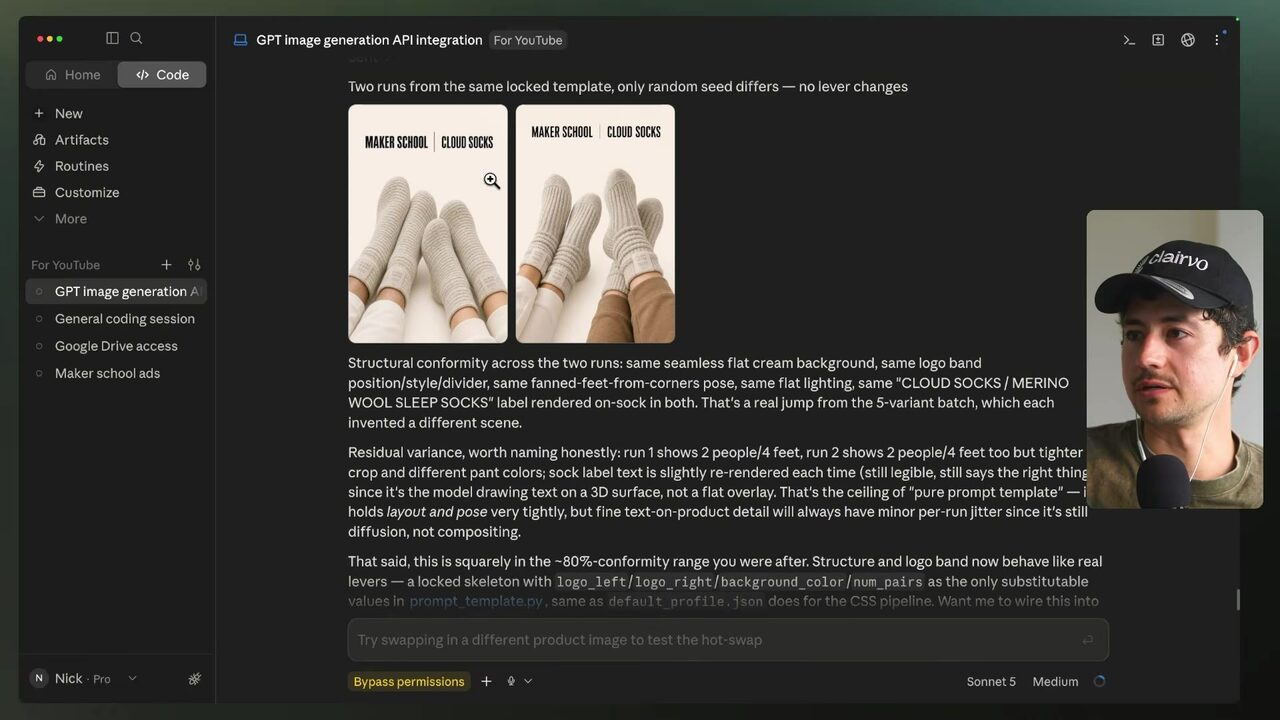
The key discipline: he advises against mixing a procedural compositing approach with AI pixel-by-pixel generation, choosing a pure prompt template instead 2:20:18. The fenced output lands much closer to the original source — pairs of raised socked feet against a plain cream background 2:21:30.
What is the actual purpose of the zone breakdown Claude produces?
Ship the daily batch, and adopt the routing rule
With the fence in place, he scales to a review pipeline. He asks Claude to turn the local flow into an HTML flow with checkboxes to select winners, generating at least five variants per template (15 total for three templates) with varied instructions like warm/cool and inside/outside 2:22:30. The app scaffolds 20 variants, lets you download selected ones, and you can adjust adherence to the template to add diversity 2:24:51.
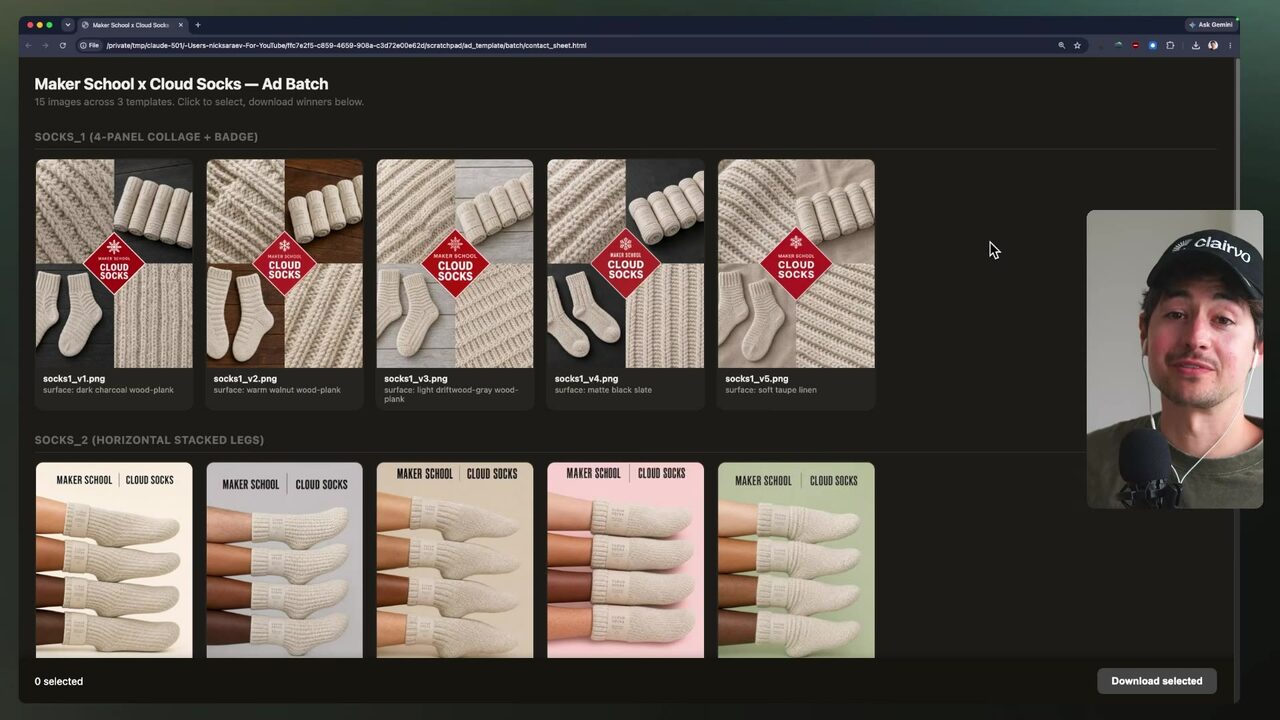
The escalation path: turn the flow into a skill, then a loop firing at 5:59 a.m. daily, generating 3 templates × 5 variants = 15 total renders 2:25:30. He creates a dedicated "routine API key" and adds it to the cloud routine's default environment in ENV format so it applies to all new sessions 2:27:00. Finally, he converts "product ad genen" into a routine mirroring the Maker School ads system — a Google Drive folder with a dated subfolder, querying the Maker School routine first for structure — with the API key in the default environment 2:28:41. The "Product Ad Gen Daily Batch" routine is active, scheduled to run daily at 5:59 AM PDT 2:31:22.
Adopt the routing rule as your standing procedure: send simple, cheap, repeatable briefs to compositing; send complex, high-value creative to direct gen — but only fenced, meaning a zone template, variation at the margins, a download picker for winners, and a mandatory human-in-the-loop review before anything ships. That rule is what lifts direct gen from ~25% to the ~80% envelope of a fenced template.
What makes the routine version distinct from the loop version?
Your score
One-sentence summary
A routing rule — compositing for repeatable, fenced direct-gen for complex — plus zone templates and a human picker lift direct-gen from ~25% to ~80% usable, shipped as a daily routine.
Glossary
Every term marked with a dotted underline above. Skim it, or search the page for a word.
Ideas worth stealing into your own setup
Proposals, not done deals: nothing gets added to your system until you choose it.
01 Client catalog routine
- Saw
- He rebuilt 'product ad genen' into a routine mirroring the Maker School ads system, with a dated Google Drive subfolder and the API key in the default environment.
- Why
- Reuse this exact routine template for a client's product catalog: save their three best Meta formats, wire a GPT Image 2 key into the routine's default env, and deliver a dated daily batch they can review by link.
- Form
- Routine
- Source
- 2:28:41 in the video
02 Template fencing service
- Saw
- He asked Claude to digest the ad, identify levers, and template changes with more conformity to the main image, aiming for an 80% success-rate template via zone constraints.
- Why
- For clients whose direct-gen tests hover near ~25% usable, encode their hero formats as zone constraints and sell the fenced, human-reviewed picker as a billable quality gate.
- Form
- Service offer
- Source
- 2:18:24 in the video
03 Two-engine routing SOP
- Saw
- He claims direct gen runs about 25% success versus 80% for compositing, and advises compositing for simple repeatable tasks and direct gen for complicated work at ~4 generations per good result.
- Why
- Codify this routing rule as an agency SOP: composite the cheap repeatable static, direct-gen the hero/launch creative, and cap spend at roughly four generations per shipped asset.
- Form
- SOP
- Source
- 2:00:32 in the video