A UGC video factory that crosses personas against products
One command produces every influencer-by-product pairing as three video candidates each, with durations chosen by script length.
💡 Dotted words are definitions
Underlined terms have plain-English definitions. Hover on desktop, tap on mobile.
✅ Quizzes keep score
Each section ends with a check. Your teacher-agent takes follow-up questions any time.
The three-piece recipe behind a UGC ad
The manual flow is the blueprint — and it starts with a UGC ad that cannot be one-shot. The speaker opens incognito, signs up at Higgsfield (raw transcript: "higsfield.ai"), dismisses the discount offers, continues with Google, and completes a human-verification step, then notes that users still have to purchase credits even after the sign-up offer 2:35:50. His plan: generate a video manually first so viewers understand the parameters, then automate the same flow with Claude Code via MCP, the Model Context Protocol, which he says lets Claude Code directly drive external tools such as Higgsfield 2:36:39.

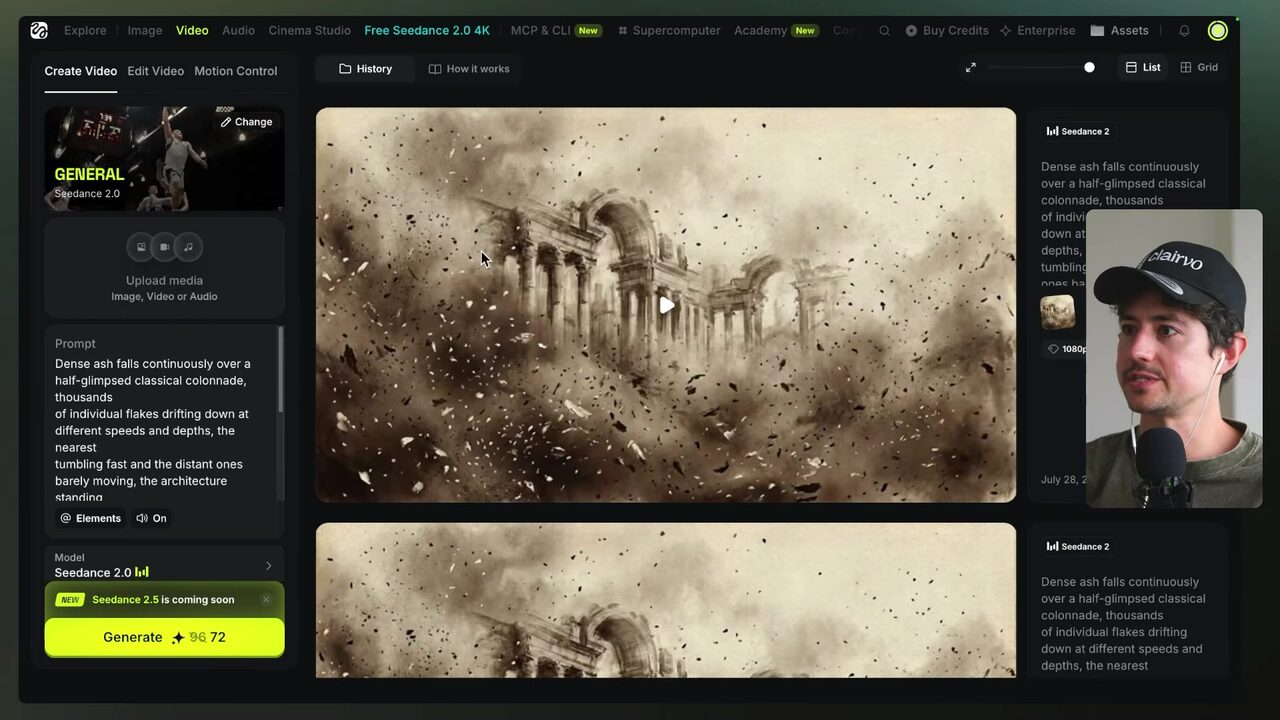
He starts in the Video tab and reviews earlier generations: ash falling in a city, a zooming wheel on an old church theme, a medieval battlefield — and flags that some are unusable, like horses running backwards, because the video model is not perfect 2:36:39. The takeaway: a convincing UGC product ad needs a product image, an influencer image, and then a video of the influencer talking about the product. He therefore goes to the Image tab rather than Video so he can generate a base frame first.
Why does the speaker refuse to one-shot a UGC video from a single prompt?
Generate a hero frame worth animating
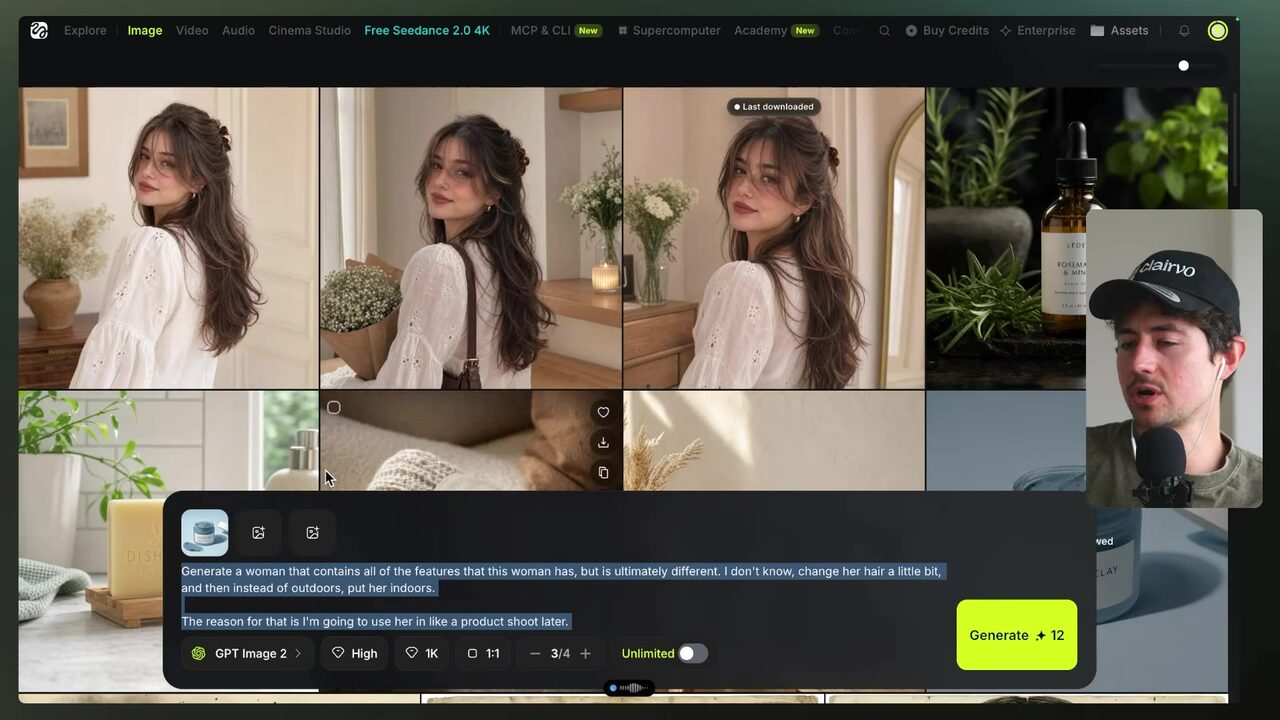
He searches Pinterest for UGC-style reference content, noting that most features women demoing products because those ads mathematically perform better 2:38:10. He selects GPT-image-2 (raw transcript: "GBT image 2"), sets high visual fidelity, 2K/1K/4K and auto size, chooses a 1:1 aspect ratio, and sets a batch size — the total number of image generations in a single run from the reference images. 2K means 2048×2048 pixels; 1K means 1024. The first prompt asks for a woman with all of the reference woman's features but different, with changed hair and placed indoors instead of outdoors, for a later product shoot; three options cost 21 credits 2:38:10.
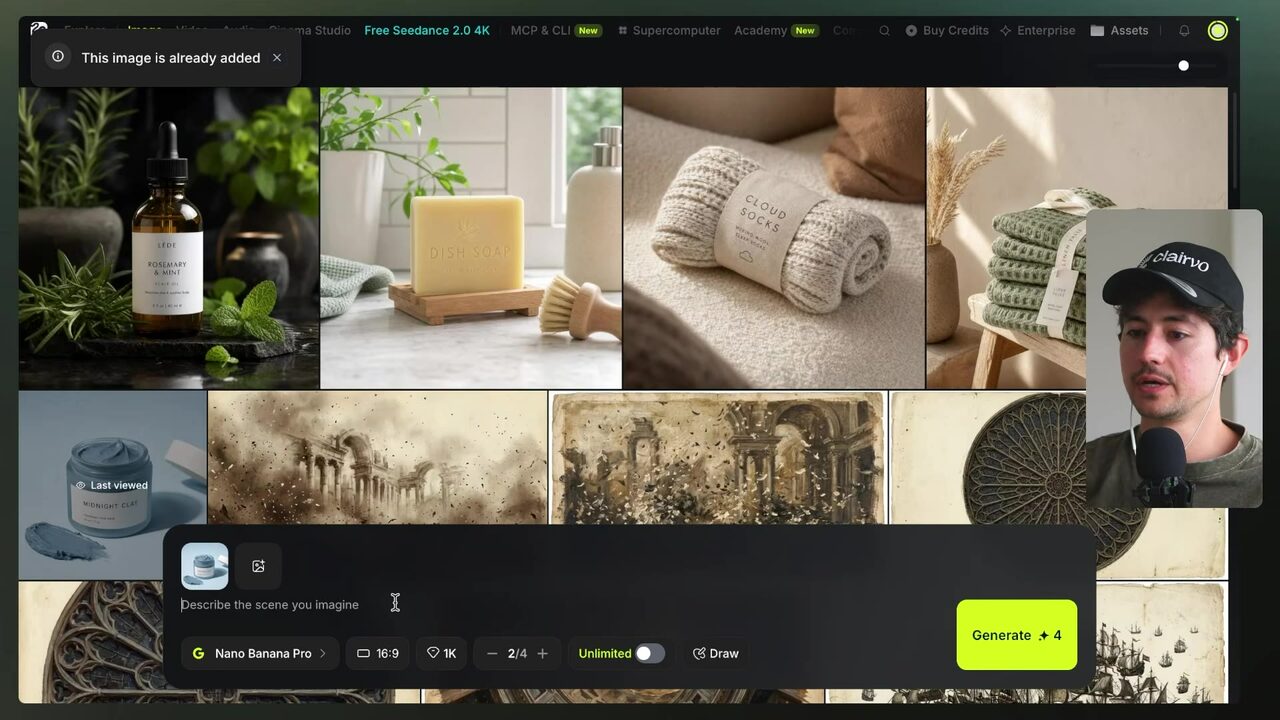
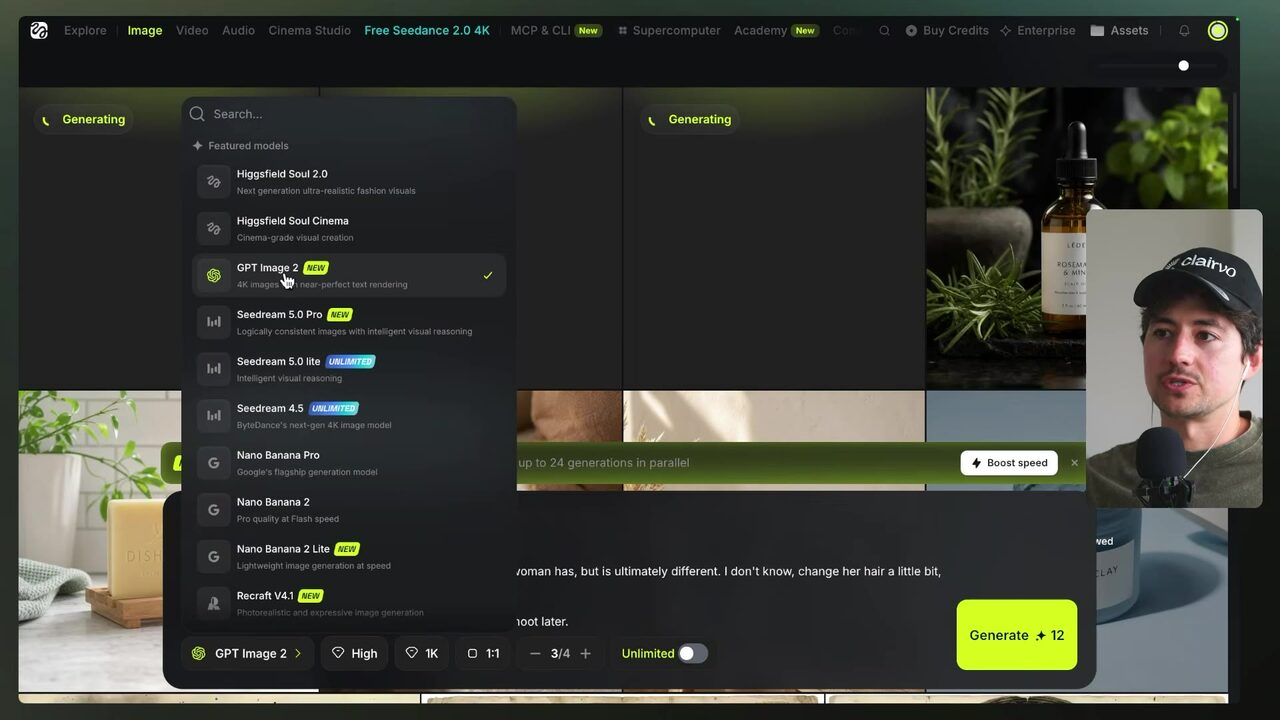
The generation is computationally intensive because the images are 2048×2048 pixels 2:39:41. Models available at recording time included Higgsfield Soul, Higgsfield Soul Cinema, and Cream 5.0 Pro, which the speaker says is "actually pretty good." Higgsfield was also offering free usage, which he characterizes as an advertising play to monetize cheap last-gen inference — his "Costco chicken" analogy: free generation brings users in, then they pay for other products 2:39:41.
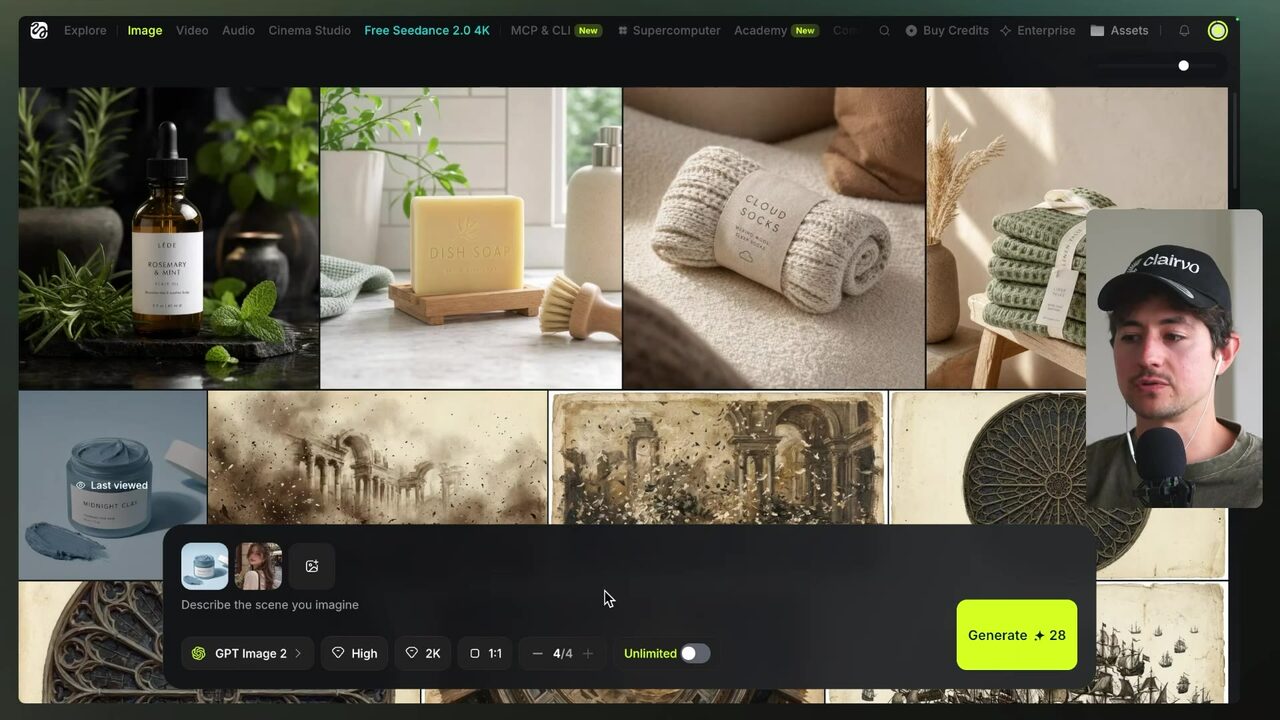
After the three options generate, he likes one because it is a little different from the original — slightly different lips but the same outfit — and observes that the selected influencer image is itself AI-generated, calling the process "putting AI on AI on AI" 2:41:12. He downloads her, uses her as the reference for the next image generation prompting for the woman holding his product, possibly in a bathroom, enthusiastic but not overselling, and one-shots this second image at 2K because the previous round showed he does not need as much diversity 2:41:12.
Why does the speaker call the process "putting AI on AI on AI"?
A VSL that reads like a real person
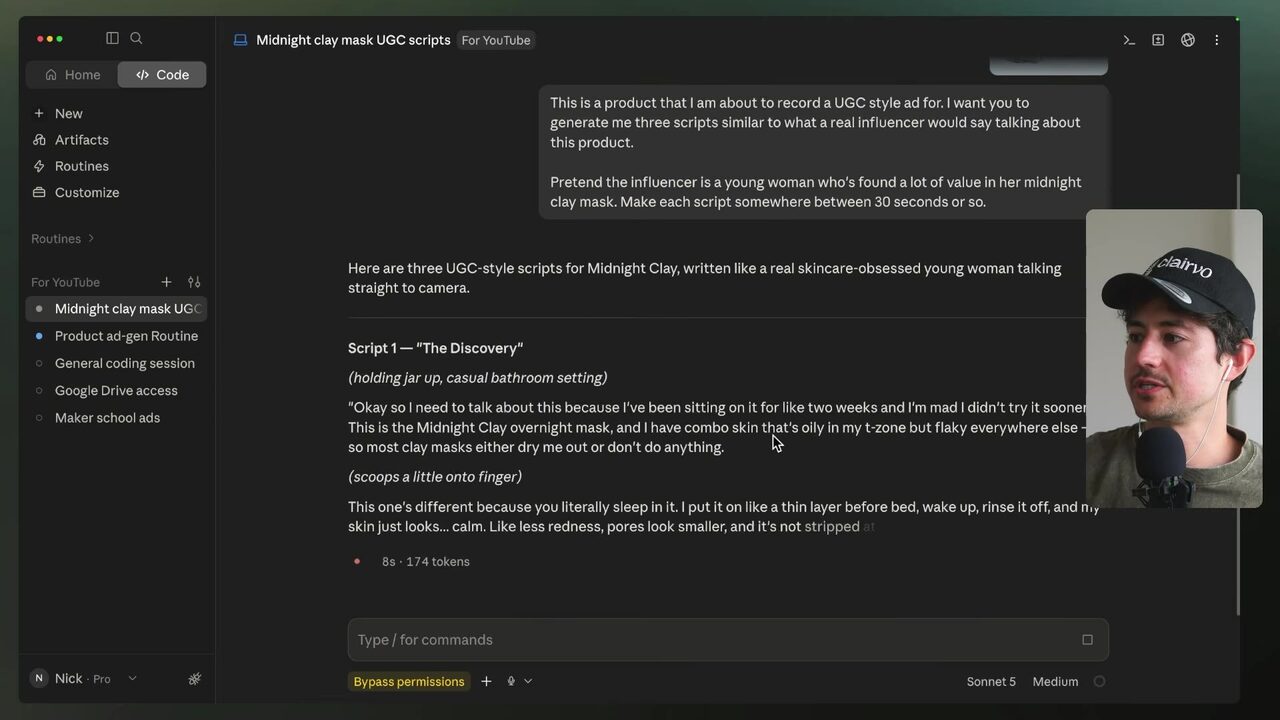
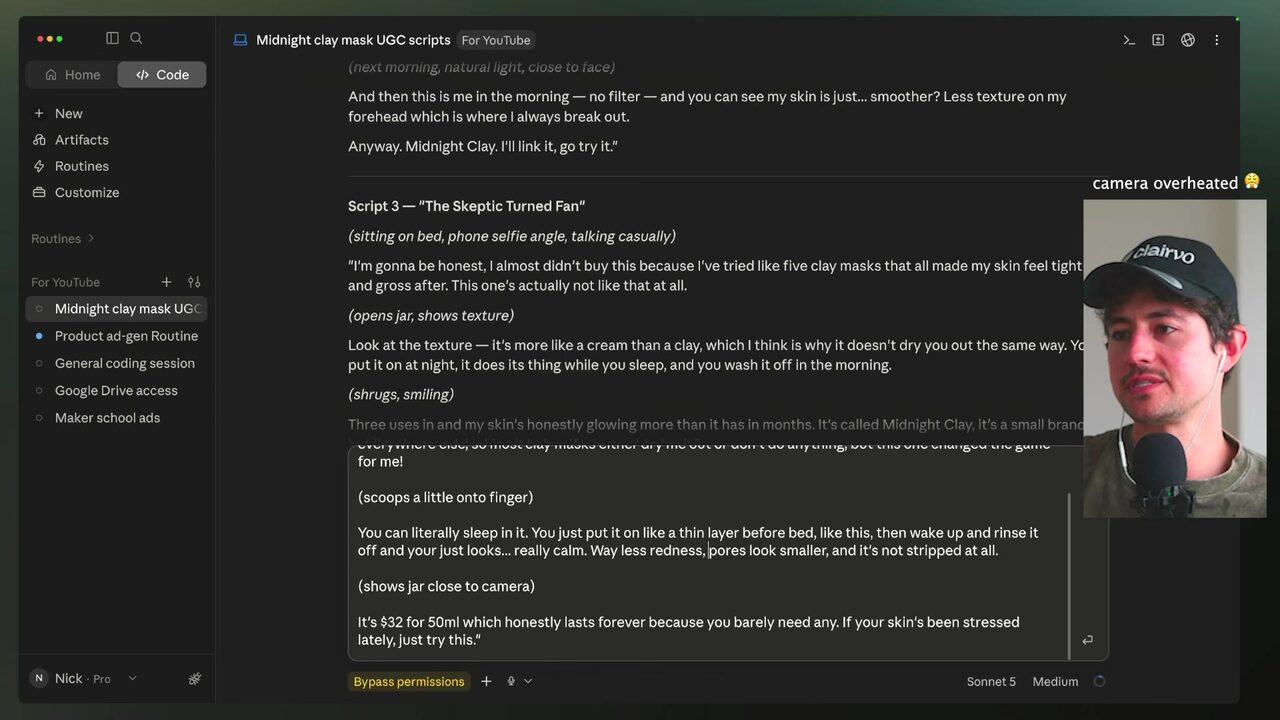
While that generation runs, he returns to Claude Code, attaches the product image, and asks for three scripts written like a real young-female influencer pitching the product, around 30 seconds long 2:42:48. This is a VSL — a video sales letter script that sells the Midnight Clay mask 2:42:48. He lightly edits the first generated script into his final version: "I need to talk about this cuz I've been sitting on it for like 2 weeks and I'm mad I didn't try it sooner. This is the midnight clay overnight mask. I have combo skin that's oily in my T-zone but flaky everywhere else. Most clay masks either dry me out or don't do anything. But this one changed the game for me..." 2:44:19. Script 3, "The Skeptic Turned Fan," appears in the generated document — the pattern of naming a persona before the pitch is what makes a batch of ten feel art-directed rather than templated.
Why does the skeptic-turned-fan framing work for a UGC video?
Pin the product so the video can't lose it
Back in Higgsfield, the generated woman is now holding the Midnight Clay mask in a bathroom setting. He turns the image into a video and plans to test a variety of video models rather than committing to one 2:44:57. He uploads the product image as a reusable element and attaches it to the prompt so the mask stays in place during generation; if the product is not uploaded, the video generation may not keep the product in the right place 2:44:57.
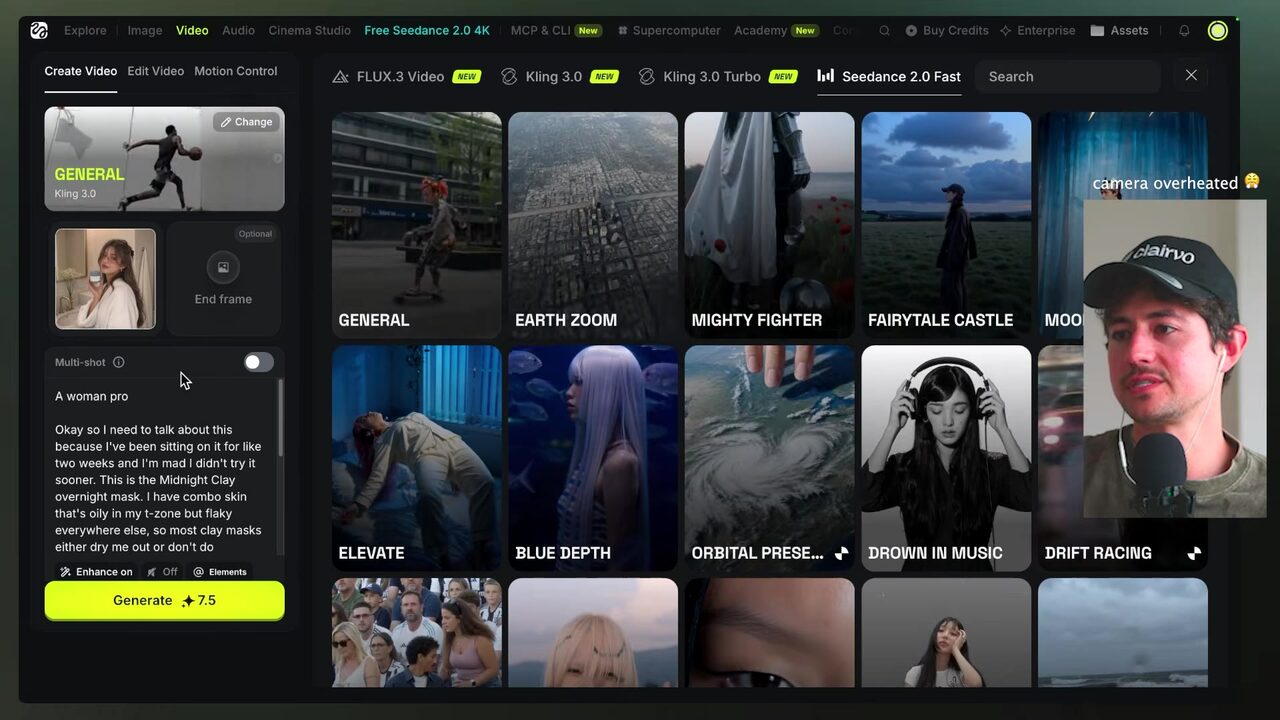
He turns on sound and generates 10 test videos on each of several models: Kling (raw transcript: "Cling"), Kling Turbo (raw transcript: "Cling Turbo"), and Cance 2.0, an unidentified model 2:44:57. A short test clip confirmed that audio works and that the woman moves her mouth while promoting the product, with even a small zoom-in 2:46:28. He expects the initial model-test round to cost roughly $10–$20 to find the best model at the time of recording. One model he calls Gemini Omni Flash is capped at 10 seconds, so he shortens the script to fit the 10-second window and uses a 16:9 aspect ratio 2:46:28.
Why does the speaker attach the product image as an element before video generation?
Voice-dump the pipeline into a skill
While generations run, he scaffolds the repeatable skill. Scripts for this flow need to be short — roughly 150–200 characters, about 27–30 words; he checks the working script and finds it at 146 characters, with room for ~170 2:47:59. He voice-dumps the manual process into Claude Code: take a product image and an influencer image, generate a starting frame of a woman holding the product with GPT-image-2, generate 10 script candidates under 35 words each, and show the frames and scripts for approval before spending video credits 2:49:30. He confirms Claude Code can call GPT-image-2 using the OpenAI API key stored in the local environment 2:49:30.
He brainstorms scaling: rather than one woman, use 20–30 different personas of varying gender, geography, age, and ICP — ideal customer profile 2:51:02. He describes the combinatorial scale: 10 influencers × 10 settings × 10 scripts equals 1,000 possible ad options 2:51:18. For QA, he proposes splitting each 10-second video into 1-second frames, feeding the screenshots to GPT or Claude Code to flag malformed content, and deleting bad variants — leaving roughly 250–500 options. Human review of 250–500 ten-second videos equals 2,500–5,000 seconds of watch time, about 40–80 minutes, and the reviewer can shortlist the top 20 performers for a small ad-budget test; the speaker claims this pipeline can effectively replace a creative department for about 1,000 times the generation cost 2:51:18.
To make the model he calls Gemini Omni Flash accessible inside Claude Code, he uses Higgsfield's MCP and CLI feature: he copies the install command from the MCP & CLI page, pastes it into Claude Code, runs it to install the Higgsfield CLI globally, then logs in to authenticate — a simpler replacement for manually fetching an API key from OpenAI 2:52:50. He dictates: take the provided hero frame as a start frame, set a 10-second total at 16:9, use the prompt "A woman influencer talking about a product," and generate three candidate options per request 2:54:21. He parallelizes by sending three jobs at once — Jobs A, B, and C in the queue — then combines their outputs.
Two failure modes surface. One video repeats "10 out of 10. Would recommend" because the script was shorter than the 10-second window, so the model padded it with repeated lines 2:56:51. Another hides a glitch where the product vanishes mid-shot — exactly why the QA step exists. He dictates one change: the duration should be dynamic — roughly 8 seconds for shorter scripts and 10 seconds for longer scripts — to save credits 2:58:22. He tells Claude Code to turn the validated flow into a repeatable skill called "AI video generator product ad skill," invokable with a simple sentence.
Why does the pipeline show candidates for approval before spending video credits?
One command → every influencer × product as 3 candidates
Claude re-confirms the pipeline: take product and influencer images as input, prep and resize them, generate hero frames, generate 10 script candidates, show frames and scripts for approval before spending video credits, generate three video candidates per approved script at 16:9, then download and deliver all candidates 2:59:58. He corrects the readback: remove the step that self-selects winner scripts, drop the fixed 8-second duration, and instead use 8 seconds for shorter scripts and 10 seconds for longer ones 2:59:58. He wants multiple influencers from a folder plus multiple products as inputs, crossed: influencer A on both product A and product B, influencer B on both product A and product B 3:00:32. The pipeline generates autonomously, delivers to a folder, requires no human oversight until the last step, and parallelizes where possible 3:00:49.
He creates a folder "video add gens video add assets" and combines assets into it 3:01:12. He defines the duration rule by word count: under 22 words uses 8 seconds; over 22 words uses 10 seconds — his script A was 28 words and worked fine at 10 seconds but felt short 3:01:12. The test uses two products: a woman with the Midnight Clay mask and a man with what looks like rosemary scalp oil, each crossed with every product 3:01:12. When running the skill, it initially misunderstood and wanted nine videos per person instead of three — roughly 420 credits; he cuts it to 360 and expects the actual total to be less because several videos run at 8 seconds 3:02:42. The run — woman × mask, woman × scalp oil, man × mask, man × scalp oil — hits a concurrency limit: only eight jobs at once, but the skill fired 12 because four pairings times three candidates. He updates the skill to cap concurrent generation at three and retries the two failed male pairings one at a time 3:02:42. Reviewing the male ads, he notes some sound staccato and that male ads tend to be worse because there is less training data on men 3:04:14.
The skill is now reproducible and could run every morning on something like 10 gens 3:05:44. He transforms it into a loop and then a routine using the Higgsfield connector: he goes to MCP and CLI, copies the URL, returns to Claude, scrolls to connectors, adds a custom connector, names it "Higgsfield," and logs in through what he calls the "OOTH flow" — likely OAuth 3:07:15. He then creates a new cloud routine, connects the Higgsfield connector, and prompts "make this a routine" 3:07:44. The routine appears as "UGC video ads daily batch" — and this step list is the contract you adopt: list files in the asset drive folder, determine which assets are new since the last run, check for a dated subfolder, build the cross of every influencer × product, generate a hero frame for each pairing, write 10 ad-copy candidates, select the best ones, determine video duration by word count, generate three video candidates per pairing, and insert the results into the Google Drive link 3:09:15. The speaker claims this pipeline runs for cents on the dollar every day and is still cheaper than using a production studio to find influencers 3:10:16.
What rule maps script length to video duration in the daily routine?
Your score
One-sentence summary
Chain a manual Higgsfield UGC flow into a Claude Code skill and then a cloud routine that crosses any folder of influencers against any folder of products, emitting three video candidates per pairing on one command.
Glossary
Every term marked with a dotted underline above. Skim it, or search the page for a word.
Ideas worth stealing into your own setup
Proposals, not done deals: nothing gets added to your system until you choose it.
01 Agency UGC batch as a client deliverable
- Saw
- The skill crosses every influencer × product pairing and emits three candidate videos per pairing.
- Why
- Package the same skill as a weekly or daily UGC batch for e-commerce clients: their product folder in, three candidates per persona × product out, with the duration-by-word-count rule baked in.
- Form
- A routine per client, invoked by one sentence.
- Source
- 3:02:42 in the video
02 QA gate as a time-compression layer
- Saw
- The speaker splits each 10-second video into 1-second frames and feeds them to GPT or Claude Code to flag malformed content.
- Why
- For your agency, this collapses 40–80 minutes of manual review into an AI triage pass: the model flags duds, your team only watches survivors.
- Form
- A review job appended to the daily batch routine.
- Source
- 2:51:18 in the video
03 Connector pattern for client tools
- Saw
- The speaker adds Higgsfield as a custom connector via the MCP & CLI URL and an OAuth-style login.
- Why
- The same connector pattern can wire your agency's other recurring SaaS tools into Claude Code routines, turning any repeatable client workflow into a routine.
- Form
- A reusable connector template for your stack.
- Source
- 3:07:15 in the video