Speed to lead as a sellable package
Form fill to personalized email and SMS inside a minute, API-triggered, packaged as the deliverable your real-estate and home-services clients leak revenue without.
💡 Dotted words are definitions
Underlined terms have plain-English definitions. Hover on desktop, tap on mobile.
✅ Quizzes keep score
Each section ends with a check. Your teacher-agent takes follow-up questions any time.
Why most companies bleed money on leads
The speaker opens with money as the measure: leads convert to revenue at an exchange rate he calls ROAS. Spend $10,000/month on leads and pull back $20,000 — that is a 2x ROAS — and he still calls it "quite poor," because roughly 50% of every earned dollar goes straight back to acquisition 4:07:44 (the raw transcript reads "2x ros"; corrected to return on ad spend). The upside is not a bigger budget — it is converting the leads you already own more efficiently.
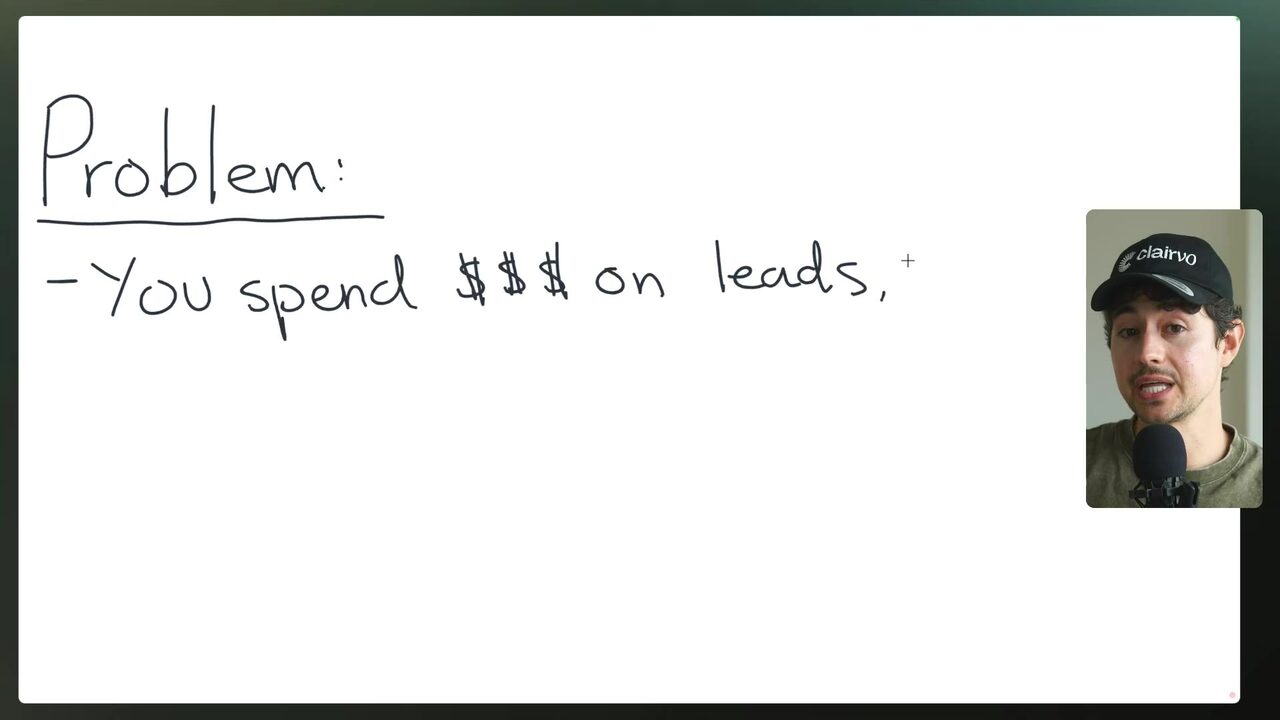
The same whiteboard names the disease: "You spend $$$ on leads, You only get $ back" 4:09:00. That asymmetry is the business case — a speed-to-lead engagement sells the delta between the $$$ you pay and the $ you keep.
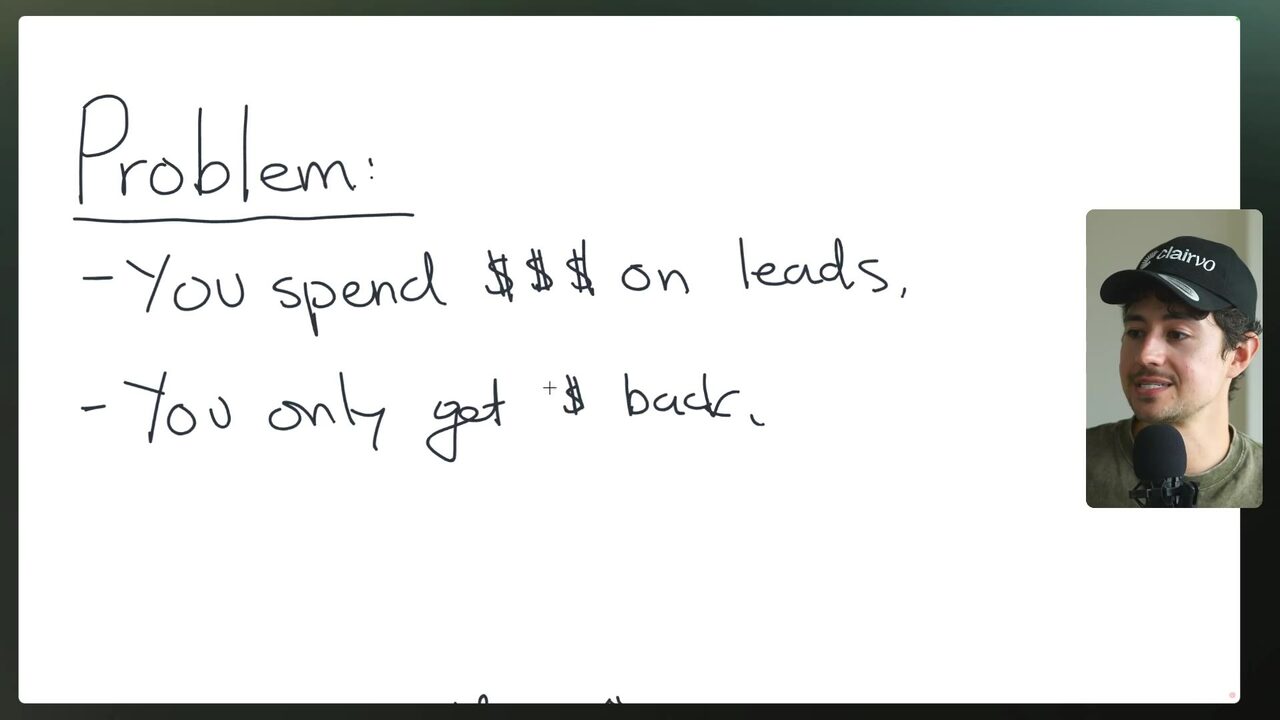
Why does the speaker call a 2x ROAS — $20k back on $10k of lead spend — "quite poor"?
The first sixty seconds decide the close
The fix is a discipline with an industry shorthand: speed to lead (S2L). The speaker built an entire business — Clearville (transcript variants "Clarabo" and "Clarvo") — around it. Its mechanics: a paid lead at roughly $30 cost per meeting is called within seconds of the form fill, texted, and followed up persistently; flows call immediately and build intelligent dispositions — outcomes that route unanswered calls to the next step most likely to get a later pickup; voicemails are left intelligently, dialing uses numbers that maximize pickup, caller ID is branded, call-center agents get live monitoring, and AI coaches the post-fill call 4:09:20.
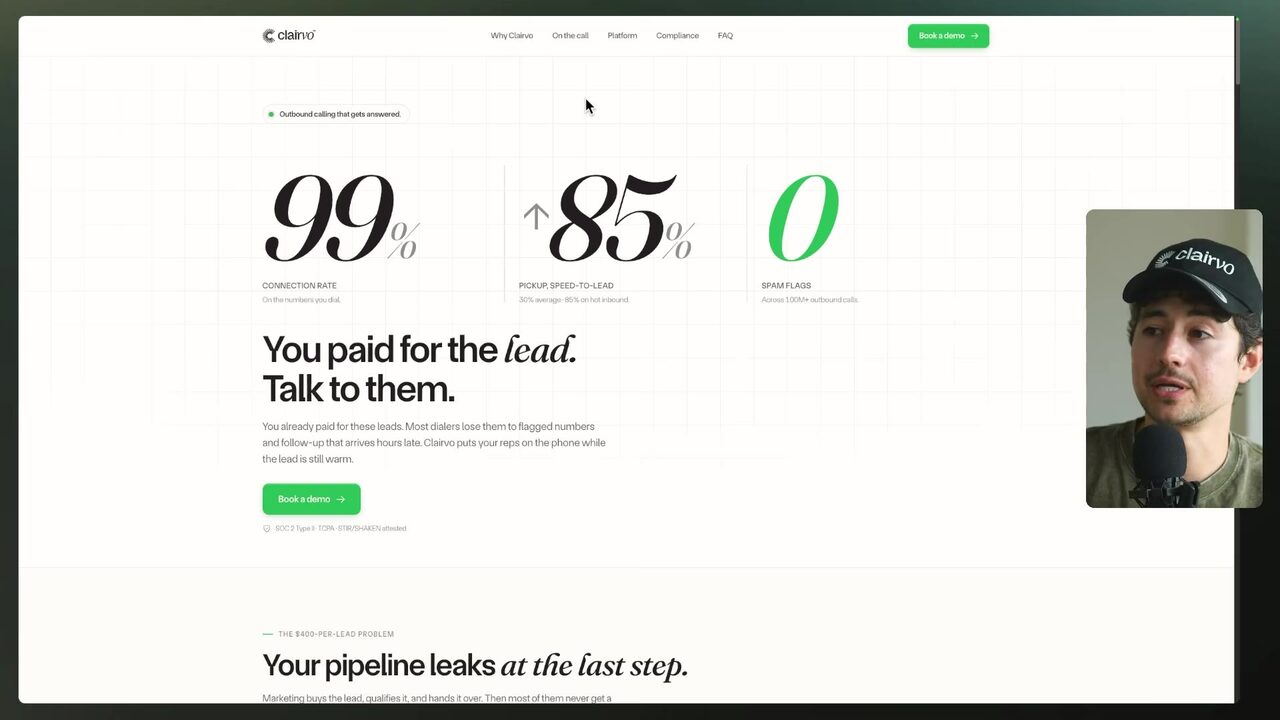
The payoff the speaker claims: a home-services client grew from $3M/month to $9M/month in revenue — 300% growth — by treating leads like gold: calling ASAP, calling consistently, and dialing with good practice 4:10:24 (a client-specific, unverified figure). The mechanism is simple: the longer a lead waits, the more the intent demonstrated at the form fill fades. The system starts from that intent event and cuts the response to under 30 seconds — ideally about 5 — with an AI-customized SMS and email built from the form fields: name, why they signed up, challenges, and opt-ins 4:11:57.
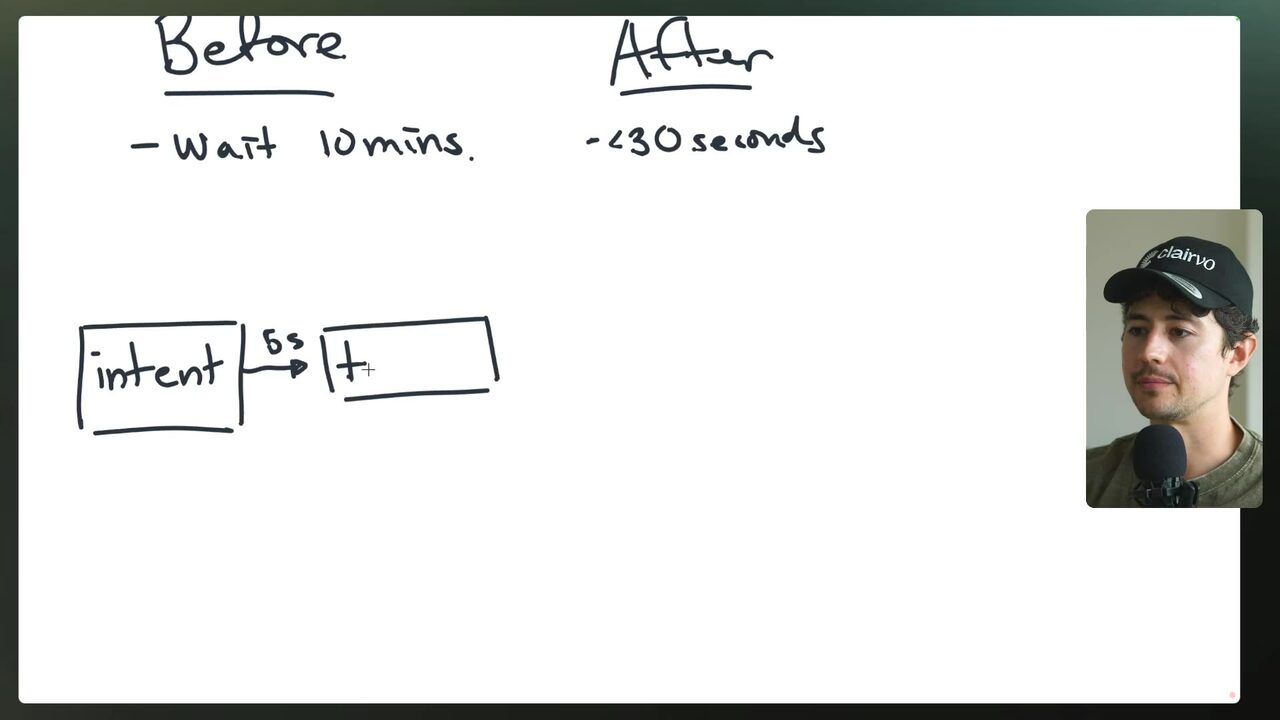
A more advanced extension is the call merge: call-center agents get merged into a call seconds after a form fill — software his own business builds 4:13:07. For Anthony, S2L is a quotable outcome: the contract sells the delta between a 10-minute dead-air window and a 30-second human-ish reply.
What makes a speed-to-lead reply feel customized rather than automated?
Build a demo your client can touch
The demo is built to be shoppable. The speaker recalls his former roommate Jonno (ledger marks the name uncertain), who ran wedding videography and once made over $20,000 in a month: about six years earlier, Jonno's website promised a call within 30–60 seconds of form fill, then a text, an email, and an automated phone merge. The speaker claims companies making $30k/month could reach $100k/month if they stopped letting leads go cold 4:14:39. The build: a hypothetical ad-driven form fill for an air-conditioning installation service, produced with Claude artifacts.
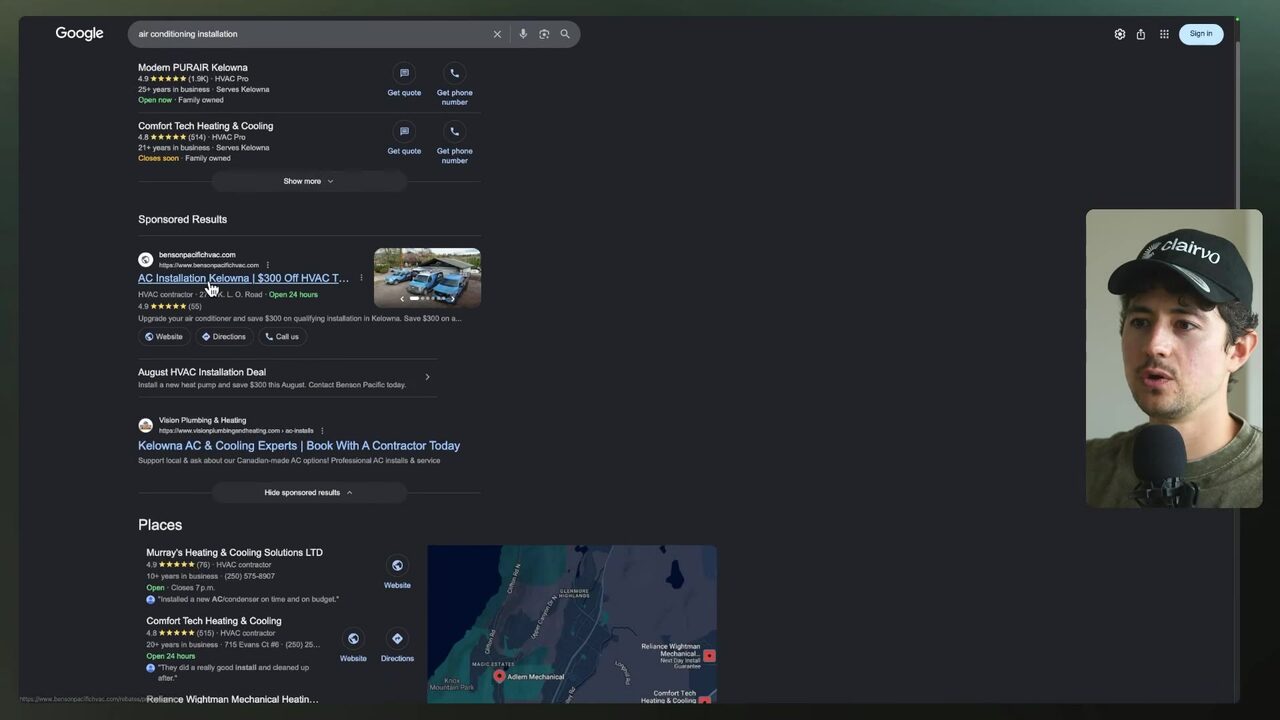
The form is the landing surface for a paid ad — the sponsored slots above organic results are where the cost per click gets spent. The speaker's Claude prompt asks for "a simple form fill for a hypothetical error conditioner installation service" that "needs to actually send me an email" 4:16:11 (corrected from the raw transcript's "error conditioner" to "air conditioner").
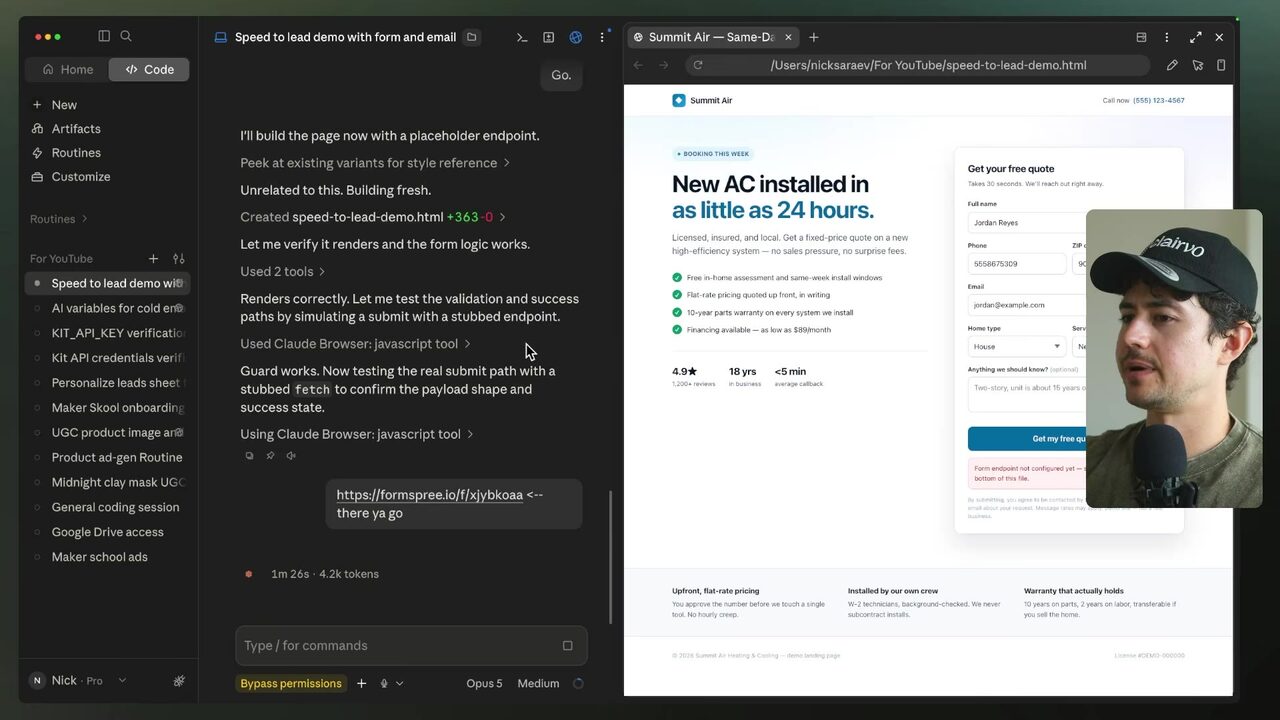
Because a static page cannot send mail, he wires Formspree (raw transcript: "Form Scree") as the form backend — "totally free," a two-second signup — and makes the "anything else we should know" field mandatory so the AI has real text to personalize on 4:17:42 and 4:18:32. That mandatory field is the product-design decision your future client will feel: every demo response reads bespoke because the form forces a reason to be.
Why does the speaker force the "anything else we should know" field to be mandatory on the Summit Air form?
From form fill to replied in a minute
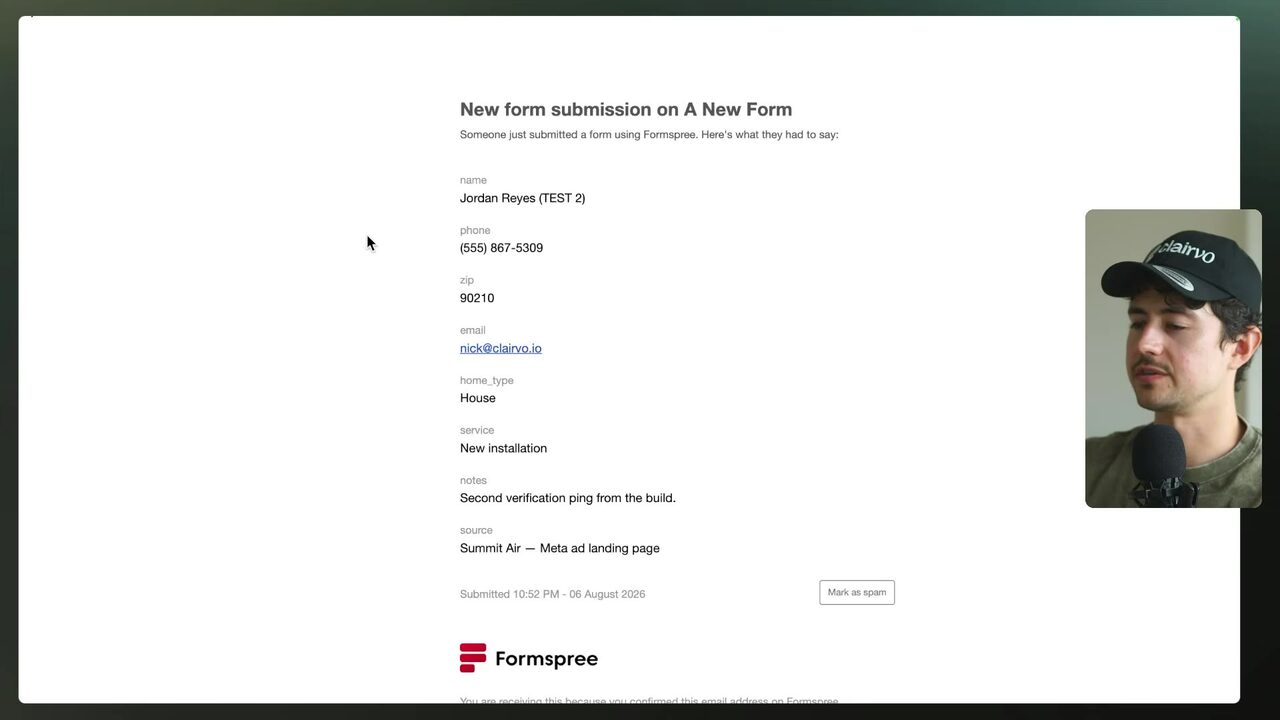
The flow that makes the win real: lead fills the ad → a polling system checks the mailbox for form-fill-shaped messages → on detection it fires a personalized email and SMS. The test submission lands as a Formspree email carrying everything the AI needs: ZIP, email, home type, service, notes, and source 4:19:20. The speaker fills it with test data — condo, new install, "Can't make the top floor cold" — and verifies it lands 4:21:40.
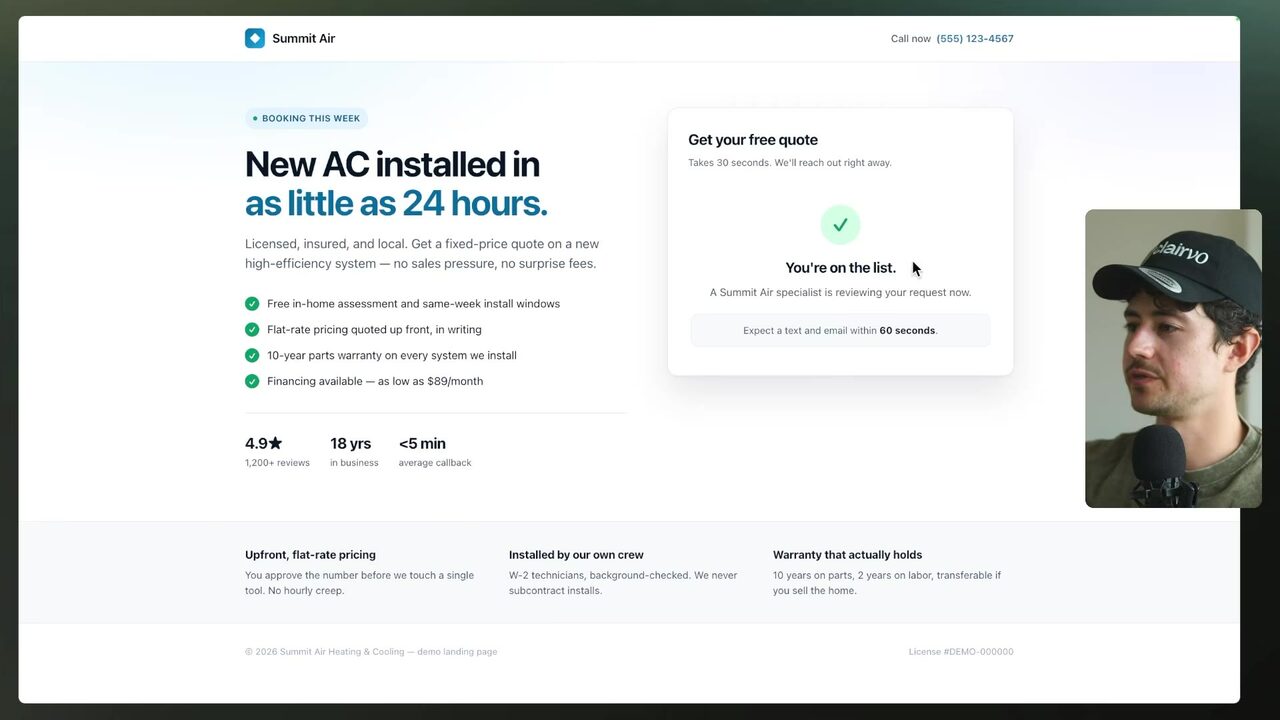
Automation must read human. The speaker deliberately spaces delivery out — 30 seconds or so — and notes that people add small spelling mistakes on purpose so a message does not scan as machine-written 4:20:09. That is the craft of S2L: speed without the artificial tell. The trigger layer uses the Gmail connector in Claude Code — it can read, compose, and send — plus a polling check that runs once a minute, verifies which leads are new, and immediately replies 4:22:22.
Why does the speaker deliberately space the automated messages out and keep tiny typos in the copy?
Package the first minute as a quotable product
Copy discipline sets the ceiling on quality. The email draft in Google Docs uses a personalized subject with the first name, a casual body paraphrasing the request, and a promise of a call within 5 minutes, signed "Jonah" (the caller's cover name, not Nick) 4:23:53. SMS obeys a 160-character limit, so the paraphrased request must run 20–30 characters to leave budget for AI variable fills like names 4:24:51; the model is instructed to hold the paraphrase at 10–15 words and not stray from the template 4:27:14. The SMS side runs on Qo (raw transcript: "Kuo"), formerly OpenPhone, with Twilio as the mainstream alternative; US texting requires A2P verification — a 2–14 day registration that can be rejected — which the speaker had to complete 4:28:46.
Then the packaging move. After connecting the Qo connector inside Claude Code settings 4:30:18, a test SMS pretending to be Dana lands on his phone 4:31:31. He turns the prompt series into a dedicated skill and tests on a new lead, Priya, with personalized email and SMS 4:32:56. The flow becomes a cloud routine named "speed to lead SMS and email" — ROUTINE.md — using only the Gmail and Qo connectors, with extraneous connectors trimmed 4:33:26. Because routines expose an API trigger, the system can wait for the form-fill event instead of polling on a timer; polling stays available as a local fallback.
For Anthony's agency, this is a product, not a demo. Deliver the form backend, a connector-scoped routine, an API token, and watchable run logs — session init, connector checks, Gmail sends — as proof of execution 4:34:26. The premium tier is call merge for mid-to-high-ticket offers that justify a live voice; the bridge number dials both parties and connects whoever answers first 4:34:26. Dispositions and CRM follow-up are explicitly sales-side and outside course scope 4:35:57 — a clean boundary to put in your statement of work so the client knows exactly what you own and what their sales team owns.
How does the speaker move the speed-to-lead flow off a polling timer and onto an event?
Your score
One-sentence summary
Speed to lead turns the first minute after a form fill into a product: an AI-personalized email and SMS, API-triggered from a cloud routine, that Anthony can quote and deliver to agency clients.
Glossary
Every term marked with a dotted underline above. Skim it, or search the page for a word.
Ideas worth stealing into your own setup
Proposals, not done deals: nothing gets added to your system until you choose it.
01 Speed-to-lead retainer for home services
- Saw
- Formspree backend plus Gmail connector answered a test AC form fill with a personalized email and SMS in under a minute
- Why
- Anthony's HVAC/plumbing clients already pay for lead gen and lose the ROI to slow follow-up; the delta they recover is the sellable outcome
- Form
- Mini build: a Summit Air-style form wired to Formspree, a Gmail connector polling each minute, and templated but personalized replies
- Source
- 4:22:22 in the video
02 API-triggered routine as productized service
- Saw
- Speaker converted the prompt series into a cloud routine (ROUTINE.md) triggered via API instead of polling
- Why
- A documented routine with an exposed token is onboarding-ready and easy to hand to a client's stack or a Zapier/Make event
- Form
- Ship a connector-scoped speed-to-lead routine with Gmail plus a texting provider; give the client the API token and run-log access
- Source
- 4:32:56 in the video
03 Call-merge premium tier
- Saw
- Speaker described merging call-center agents into calls seconds after a form fill using a bridge number
- Why
- Mid-to-high-ticket offers justify a live voice, so Anthony can tier pricing: email and SMS base with a call-merge add-on
- Form
- Add a Qo/Twilio bridge number that dials the lead and the agent simultaneously when a form files
- Source
- 4:34:26 in the video